
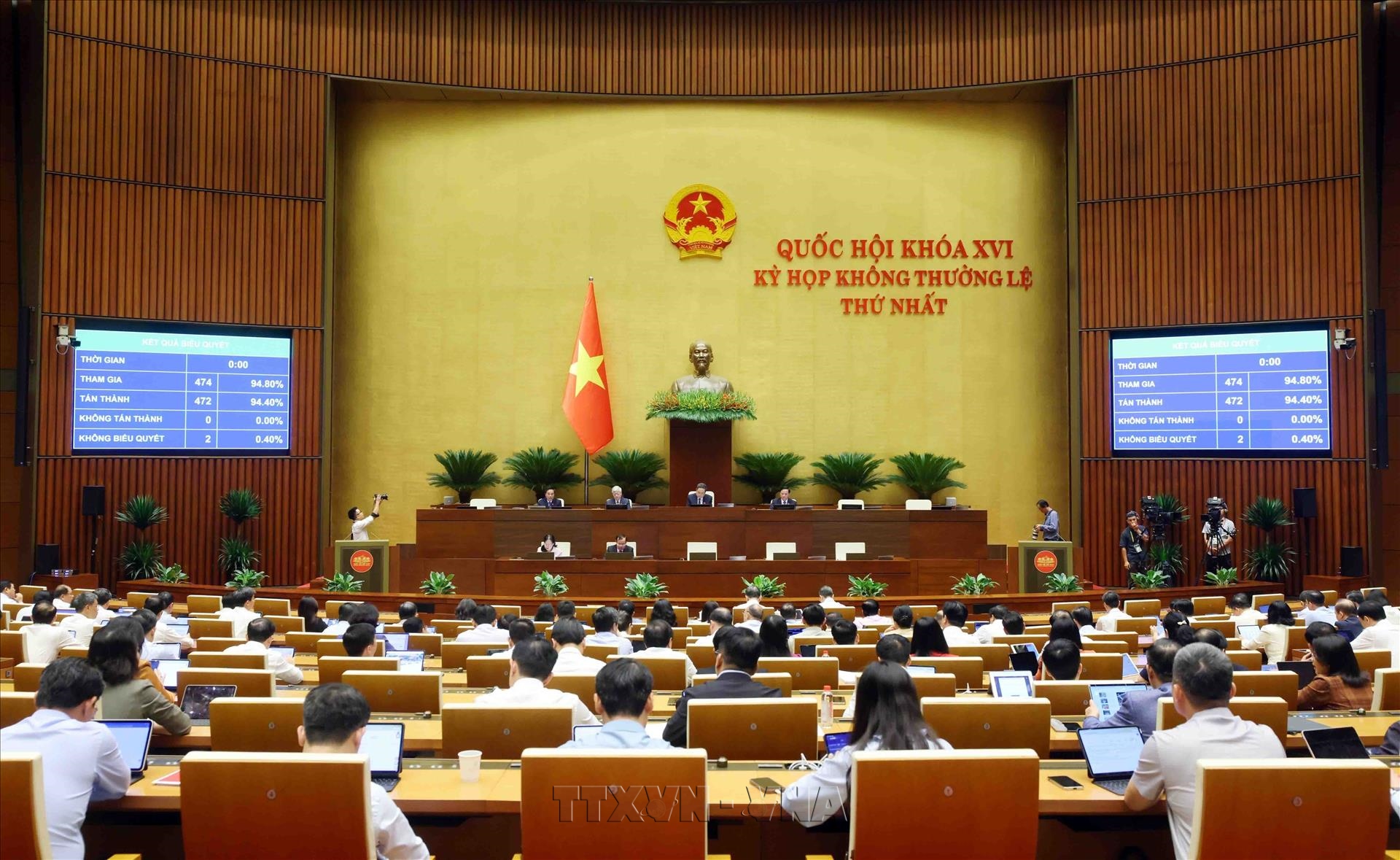
The 16th National Assembly (NA), during its first extraordinary session on August 23, passed three laws, including the revised Law on Dissemination and Education of Law, which shifts the approach from one-way information delivery to a more proactive, interactive and technology-driven model centred on people and businesses.
With 466 of 475 participating deputies voting in favour, or 93.20%, the NA passed the revised Law on Dissemination and Education of Law, which will take effect on March 1, 2027.
Presenting the Government’s report on the draft law, Minister of Justice Hoang Thanh Tung said the legislation had been comprehensively revised to promote a renewed mindset in lawmaking while ensuring the principles of constitutionality, consistency and coherence within the legal system.
The revised law moves legal dissemination and education from simply providing legal information to creating an enabling environment that helps people and businesses access, study and apply the law proactively and effectively. It also encourages the use of digital technologies and artificial intelligence (AI) to enhance interaction.
The law prioritises digital transformation and AI application, while providing for the development of digital human resources and digital skills for those involved in legal dissemination, education and policy communications.
It also defines the National Legal Portal as a shared national digital platform for legal information, encouraging organisations and individuals to disseminate legal knowledge through digital platforms, social media and AI. At the same time, it provides for stricter verification and management of legal information disseminated through such channels.
The revised law adds several disadvantaged or specific groups to those eligible for legal dissemination and education, including people from poor and near-poor households, elderly people and those who have completed prison sentences and are reintegrating into the community.
It also provides conditions for overseas Vietnamese to study and learn about Vietnamese law.
The NA also passed the revised Law amending and supplementing a number of articles of the Law on Customs, with 471 of 474 participating deputies voting in favour, or 94.20%. The law will take effect on March 1, 2027.
The revised law adds the principle that paper documents already shared through the national one-stop shop mechanism will not have to be resubmitted. It also clarifies data-sharing and coordination through the mechanism and prioritises investment in digital customs infrastructure.
It also adds obligations for new groups of stakeholders, including postal and express delivery businesses, e-commerce platform operators and transit service providers, in line with the Kyoto Convention and international practices.
It establishes basic principles for the inspection and supervision of imports and exports traded through e-commerce platforms, while assigning the Government to set detailed value thresholds, procedures and timelines for electronic identity verification.
With 473 of 475 participating deputies voting in favour, or 94.60%, the NA passed the revised Law on Petroleum, which will also take effect on March 1, 2027.
The revised legislation addresses administrative procedures, decentralisation, science and technology, innovation, digital transformation, gender equality and ethnic minority policies.
It also covers the capture, treatment, transportation, injection and storage of CO2; application of advanced technologies and services; and the development of offshore energy infrastructure linked to petroleum activities.
The law strengthens decentralisation in petroleum management and grants additional authority to the Vietnam National Industry - Energy Group (Petrovietnam), while providing incentives for petroleum activities and policies for the recovery of marginal fields and petroleum blocks. It also clarifies provisions on petroleum contracts, field development and early production plans, as well as the handling of PetroVietnam’s costs and transitional provisions./.