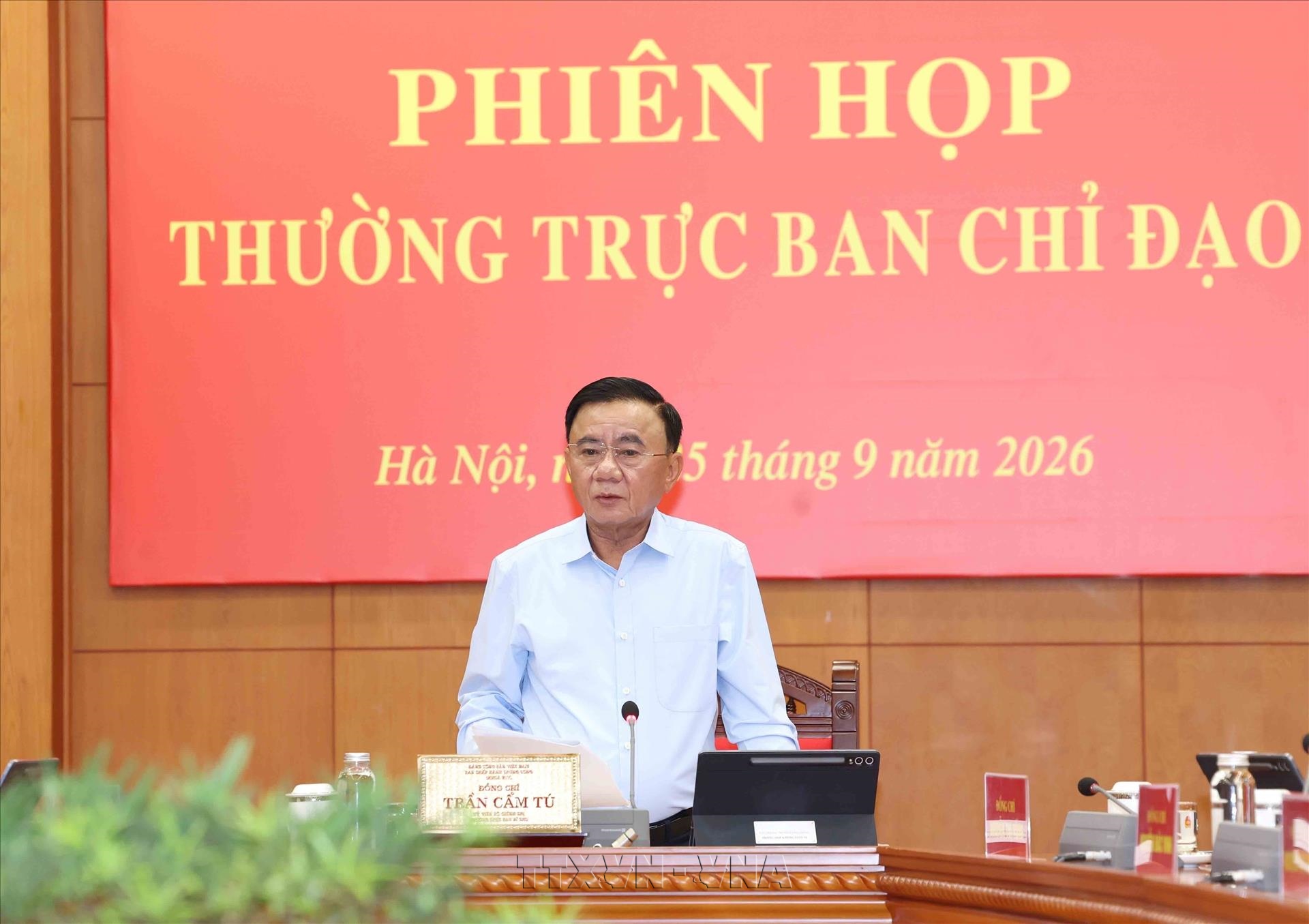
Politburo Member and Standing Member of the Party Central Committee’s Secretariat and Head of the Central Steering Committee for the Development of Vietnamese Culture Tran Cam Tu on September 25 asked for concerted implementation of Resolution No. 80-NQ/TW on cultural development and related Party policies, with practical solutions needed to address bottlenecks and drive major shifts in the sector.
He made the request while chairing a meeting of the steering committee’s standing members in Hanoi to deploy tasks for the fourth quarter of 2026.
The meeting reviewed the implementation of Resolution No.80 of the Political Bureau, and directions by General Secretary of the Communist Party of Vietnam Central Committee and President To Lam at the Central Steering Committee’s second meeting on July 13; and discussed preparations for the fourth National Cultural Conference and Vietnam Cultural Day on November 24.
The key leader noted clear and positive changes in the political system’s awareness and actions regarding cultural development, with the National Assembly adopting the amended Publishing Law and Resolution No. 28 on cultural development, while the Government issued six decrees and the Prime Minister issued three vital decisions. Several major localities have also introduced policies and plans to mobilise resources for culture.
He highlighted four gaps identified by the General Secretary and President: limited capacity to promote positive cultural values in the digital environment; inadequate ability to turn heritage into data, digital knowledge, intellectual property and creative resources; limited capacity to develop competitive cultural products; and institutional and ecosystem shortcomings in developing cultural industries.
Resolution No. 80 aims to raise the contribution of cultural industries to GDP from about 4% currently to 7% by 2030 and 9% by 2045.
Emphasising the strategic orientations set out in the Resolution, he called for deeper study and thorough implementation of the top leader’s directions, particularly three major shifts in Vietnam’s cultural development - viewing culture as a spiritual foundation, pillar of development and new growth driver; expanding cultural development into both physical and digital spaces; and combining preservation with creativity to generate new knowledge, products, markets and national soft power.
He also requested completion of the draft law on cultural industry development and policies concerning decentralisation, investment, land, copyright and public-private partnerships.
Cultural spending should reach at least 2% of total State budget expenditure, with greater efficiency in allocation and disbursement and stronger mobilisation of social resources, he noted.
He also called for faster digital transformation and stronger cultural data infrastructure, with a unified, interconnected national digital cultural database that can be verified and used sustainably, alongside tools to measure cultural development, including the National Cultural Index and indicators of the cultural industries’ contribution to economic growth.
Conservation must be linked with the promotion of values, education, creativity and development, ensuring that heritage does not merely exist as resources that have yet to be transformed into knowledge and new values, he said.
The meeting also discussed measures to develop cultural industries as a contributor to double-digit economic growth, including identifying promising fields, leading localities, businesses and projects with potential to generate products, jobs, intellectual property and markets.
The Government needs to urgently complete and operationalise the national statistical system for cultural industries, establishing baseline data, a unified methodology and a regular reporting mechanism in 2026. The system should measure contributions of each industry and locality, domestic and export revenues, enterprises, employment and income, copyright and intellectual property values, and Vietnamese firms’ participation in value chains, the key leader said.
“Each locality should select only a few suitable sectors and a small number of flagship projects. Each project must clearly identify its products, implementing enterprise, funding sources, market, intellectual property assets, and expected contributions to GRDP, employment, exports and tourism attraction,” he added.
Regarding preparations for the Vietnam Cultural Day, he asked ministries, sectors and localities to consider reducing or waiving fees at public cultural and sports facilities on November 24 and organise practical grassroots activities./.