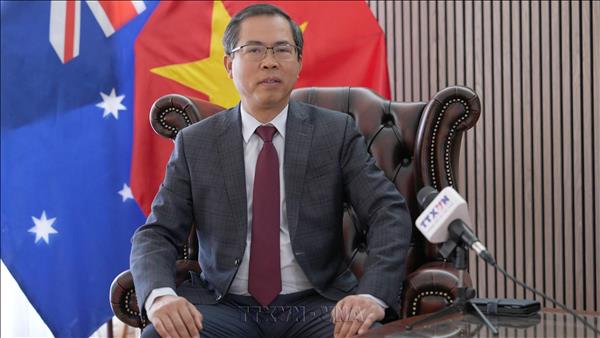
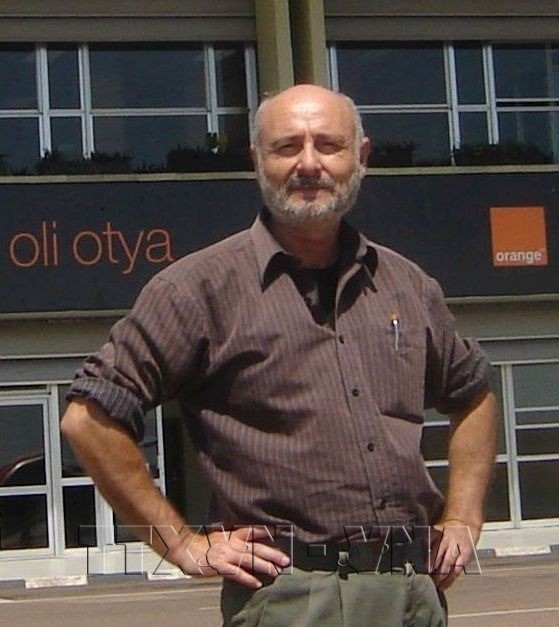
Israeli technology expert Mel Shalev. Photo: Published by VNA
In an interview granted to the Vietnam News Agency, Shalev, a former senior technology specialist with more than 40 years of experience, including 37 years at IBM, shared Israel’s experience in developing its semiconductor industry and discussed prospects for high-tech cooperation between the two countries.
He noted that Israel hosts more than 250 semiconductor companies, most being quite small and highly specialised. Intel and Nvidia are major employers in the sector, which accounts for nearly 8% of the country’s technological workforce. The country now has around 32,000 engineers, including 10,000 software specialists, along with some 2,500 scientists and 10,500 technicians.
Shalev said Israel’s focus is shifting from Intel-led manufacturing/research and development (R&D) towards artificial intelligence (AI), high-speed networking and data centre chips, areas where Nvidia is strong at.
Israel’s original motivation to invest in the semiconductor industry was a mixture of two compelling strategic necessities: defence and defence export economics, he said, adding that while there was no plan to make Israel a global semiconductor power or hub, the sector evolved from several converging pressures and opportunities.
The defence-electronics ecosystem created the demand, the engineers, the universities, and the industrial culture that made semiconductors a natural choice. Israeli defence R&D had an outsized effect on the country's semiconductor technological and industrial capabilities, including its supply of scientists and engineers.
While a fab that requires billions of US dollars, water, power, infrastructure, and long-term state incentives, design centres are much less capital-intensive than fabs. Given this, Israel used fabs sparsely as anchors and in parallel, ramped up the sector mainly through design, verification, embedded software, communications chips, AI accelerators, and specialty semiconductors.
Drawing on Israel’s experience, he said Vietnam should focus on developing talent, scientific research, and chip design capabilities instead of rushing into building fabrication facilities.
On bilateral cooperation, Shalev identified research, talent development, and technology transfer as three priority areas.
He suggested Vietnam expand partnerships with leading Israeli universities, including the Technion, Tel Aviv University, and the Hebrew University of Jerusalem, while promoting joint research programmes with Vietnamese institutions.
The expert voiced his belief that technology transfer will be the natural next step to successful joint talent development and joint research.
Shalev also highlighted promising cooperation in medical devices, electric vehicles (EVs), smart agriculture, financial technology, and defence technology.
Among these, he described EVs as the most promising field, noting that Vietnam has a rapidly growing EV ecosystem while Israel has strong automotive R&D capabilities.
He cited Israeli company REE Automotive, which has developed a modular EV platform featuring a flat bottom chassis on which different (initially commercial) vehicle bodies can be mounted. Its key innovation is a wheel module combining steering, braking, suspension, powertrain and control into compact units near the wheels. This "roll by wire" architecture enables considerable freedom of body design.
Electric aviation is another area with strong potential, with companies such as Israel Aerospace Industries, AIR, and Eviation identified as potential partners for future joint research and development, according to the expert.
Regarding the Vietnam–Israel Free Trade Agreement (VIFTA), Shalev described the agreement as an important milestone that enhances the confidence and trust needed to initiate major joint development projects.
Beyond high technology, he said the agreement also opens up opportunities in tourism and agriculture. Israelis of all generations, especially the generation of young adults, are inveterate travellers, and Vietnam offers many choices to these active travellers. Meanwhile, there is much room for Vietnam's expansion of coffee, seafood, and agricultural products to Israel while deepening cooperation in agricultural technology.
He added that improving logistics links, particularly maritime routes connecting Vietnam with Israel’s Port of Eilat, will reduce transport costs and further strengthen bilateral economic ties./.