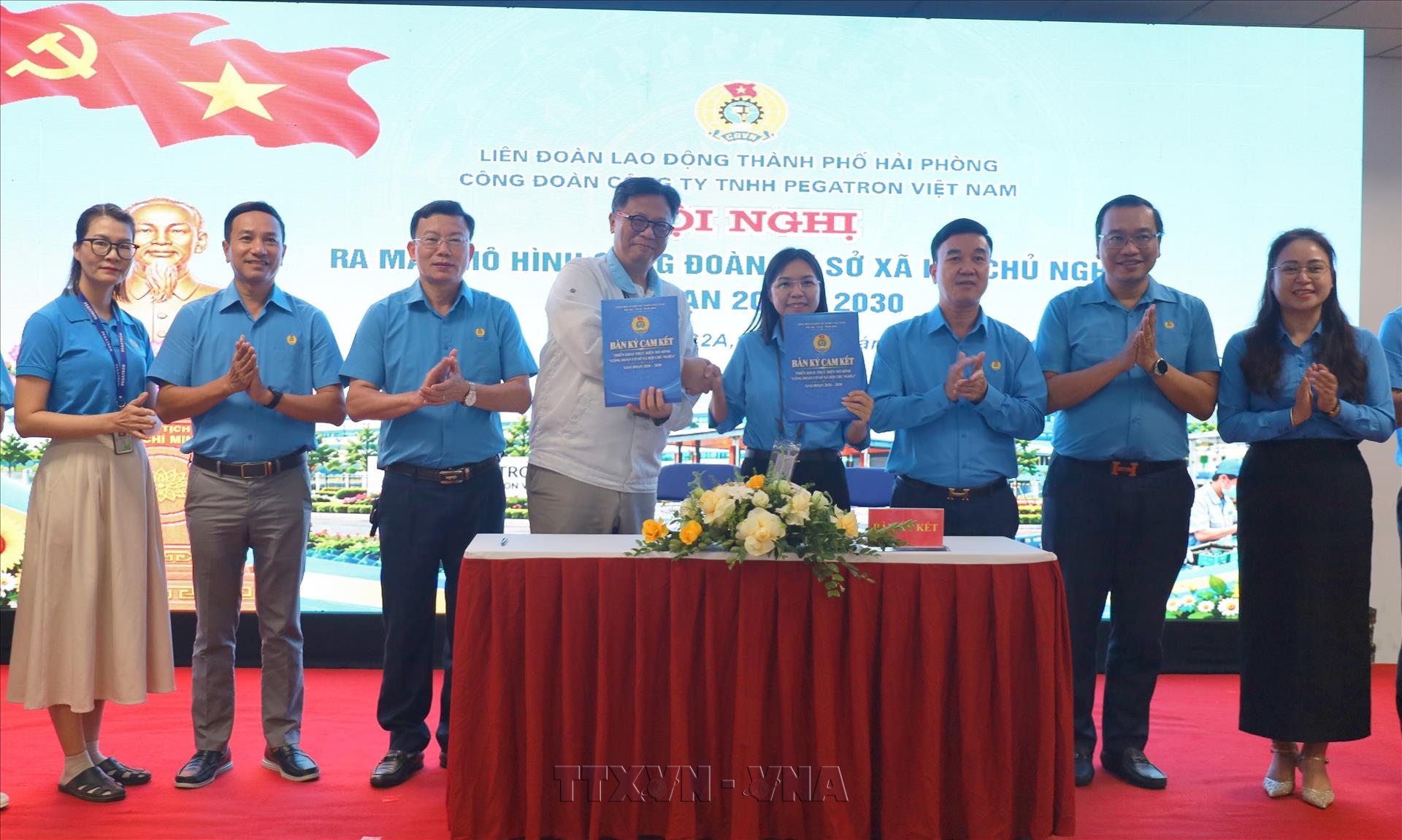
Representatives of the leadership and the trade union of the Pegatron Vietnam Co. Ltd sign a commitment. Photo: VNA
Vong Thanh Sang, Chairwoman of the Pegatron Vietnam trade union, said that the company, invested by Taiwan (China), was established on March 17, 2020. It manufactures and assembles electronic components and equipment, primarily for export.
Its trade union was established in 2023 with an initial membership of 465. Since then, the organisation has expanded rapidly alongside the company’s production growth. Figures compiled for the development of the model in 2026 show that the company employs 8,830 workers, of whom 7,238 are trade union members.
Nguyen Van Thach, Chairman of the LG Innotek Vietnam Hai Phong trade union, said the wholly Korean-invested company, based in Trang Due Industrial Park, was established on September 5, 2016. Its trade union gathers all the 6,225 employees.
To establish the “socialist grassroots trade union” model, both trade unions have worked to fulfil the role in representing members and workers, caring for and protecting their legitimate rights and interests, and participating in the development and supervision of the implementation of workplace policies. They have also organised emulation movements and activities to improve workers’ material and spiritual well-being and strengthen their apparatuses.
Speaking at the launch ceremonies, Huang Jen Chieh, General Director of Pegatron Vietnam, and Kim Jong Kook, Deputy General Director of LG Innotek Vietnam Hai Phong, praised the trade unions’ activities.
They expressed confidence that the “socialist grassroots trade union” model will help build a skilled workforce with professional industrial discipline and an innovative spirit, while enhancing workers’ commitment to their companies. It will also help businesses consolidate their human resource foundations to support their development strategies.
At the event, Nguyen Van Quyet, Standing Vice Chairman of the Hai Phong Labour Federation, said the model is launched as Vietnam is entering a new stage of development, in which science – technology, innovation, digital transformation and workforce quality are increasingly important drivers of growth.
The municipal Labour Federation is introducing the model directly at enterprises, thus translating requirements for better worker welfare, skills development, innovation, industrial discipline and stable labour relations into practical measures during the production process.
Quyet urged the two trade unions to maintain close coordination with their companies' leaders to improve the quality of worker representation, welfare and protection of legitimate rights and interests.
They were asked to work with the firms' leaders to improve workers’ skills and ability to adapt to new technologies. Training should be tailored to specific jobs, with a focus on occupational skills, quality control, equipment operation, safety and digital skills, while cultural, sports and healthcare activities should be maintained in ways that suit shift schedules.
Grassroots trade unions should also proactively understand members’ circumstances and needs, and propose support from higher-level trade unions to ensure that programmes and resources reach the right people, meet the right needs and arrive at the right time, Quyet added.
He said the federation will continue supporting grassroots trade unions in implementing the model through professional and operational guidance, as well as by connecting them with resources to improve member and worker welfare./.