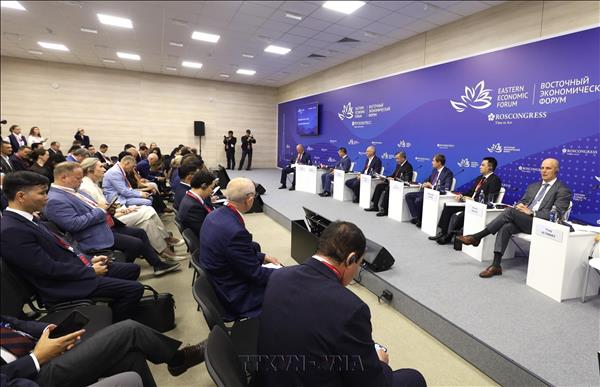
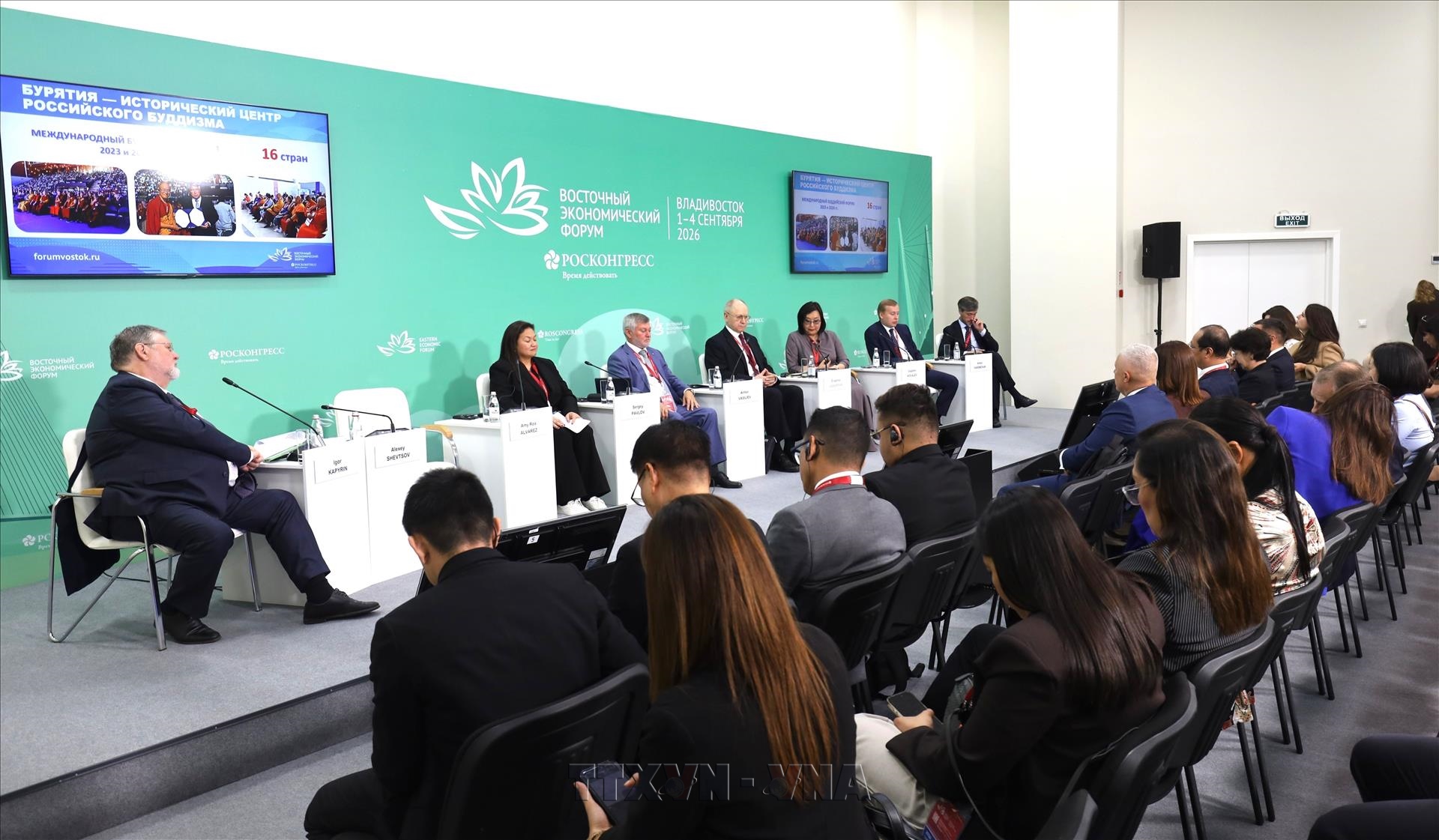
The call was made by Vietnamese Consul General in Vladivostok Nguyen Viet Kien at a panel discussion on “Eurasian Connectivity: Challenges and Directions for Promoting Cooperation”, held by the Russian Ministry of Foreign Affairs on September 2 as part of the 11th Eastern Economic Forum (EEF).
Participants said Eurasian integration is at a critical juncture. Swift global economic changes, shifting global supply chains and growing demand for new transport and logistics routes are creating opportunities. Meanwhile, geopolitical competition, economic fragmentation, trade and investment restrictions, and differences in regimes pose growing challenges to connectivity.
They highlighted the expanding role of the Association of Southeast Asian Nations (ASEAN) in ASEAN-led mechanisms such as ASEAN Plus Three (ASEAN+3), the East Asia Summit (EAS), the ASEAN Regional Forum (ARF), the ASEAN Defence Ministers' Meeting Plus (ADMM+) and the Asia-Europe Meeting (ASEM), as well as the importance of the Eurasian Economic Union (EAEU) and other bilateral and inter-regional cooperation frameworks.
ASEAN’s cooperation with partners, including Russia, is also moving strongly from basic connectivity towards deeper physical, institutional, digital and people-to-people links.
They assessed the EAEU as a significant model of economic integration within the Eurasian region, facilitating the flows of goods, services, and investment, as well as policy coordination among its members.
To Vietnam, its free trade agreement with the EAEU, which took effect in 2016, has provided an important foundation for economic cooperation, with Vietnam–EAEU trade nearly doubling over the past decade.
However, participants noted several obstacles, including geoeconomic and geopolitical fragmentation that raises trade, investment and transport costs, gaps in infrastructure, limited participation by SMEs in cross-border networks, and inadequate attention to human resources connectivity.
Drawing on Vietnam’s and ASEAN’s experience, Kien called for an open, inclusive and mutually beneficial model of Eurasian connectivity, building a peaceful, stable, open, and well-connected Eurasian space that brings benefits to all nations.
Central to this process is the interconnection of mechanisms, economic corridors, and communities; however, these various mechanisms should not compete to exclude one another but rather complement each other, he said.
The Consul General urged countries to move from “connecting ideas” to “connecting projects”, prioritising multimodal transport, logistics, seaports, economic corridors, e-commerce and digital infrastructure, while simplifying customs procedures, improving data interoperability and facilitating convenient payment solutions.
He also called on countries in the region to establish direct cooperation networks among localitiess, businesses and research institutions, in which such forums as the EEF has a crucial role to play to bridge administrations with businesses, businesses with businesses, and people with people.
He recommended that countries place people at the heart of Eurasian connectivity by expanding cooperation in education, tourism, culture, science and technology, human resources training, and youth exchanges.
When citizens and the business community see the direct benefits of cooperation, regional integration will rest on a more sustainable foundation, Kien went on.
To further accelerate Eurasian integration, the Vietnamese diplomat asked countries to move from dialogue to action and from isolated initiatives to complementary connectivity networks, creating new trade routes and development opportunities for regional countries.
He affirmed Vietnam’s readiness to contribute actively to stronger connectivity between Southeast Asia and Eurasian partners, including Russia and the Russian Far East, based on equality, mutual benefit, respect for international law and sustainable development./.