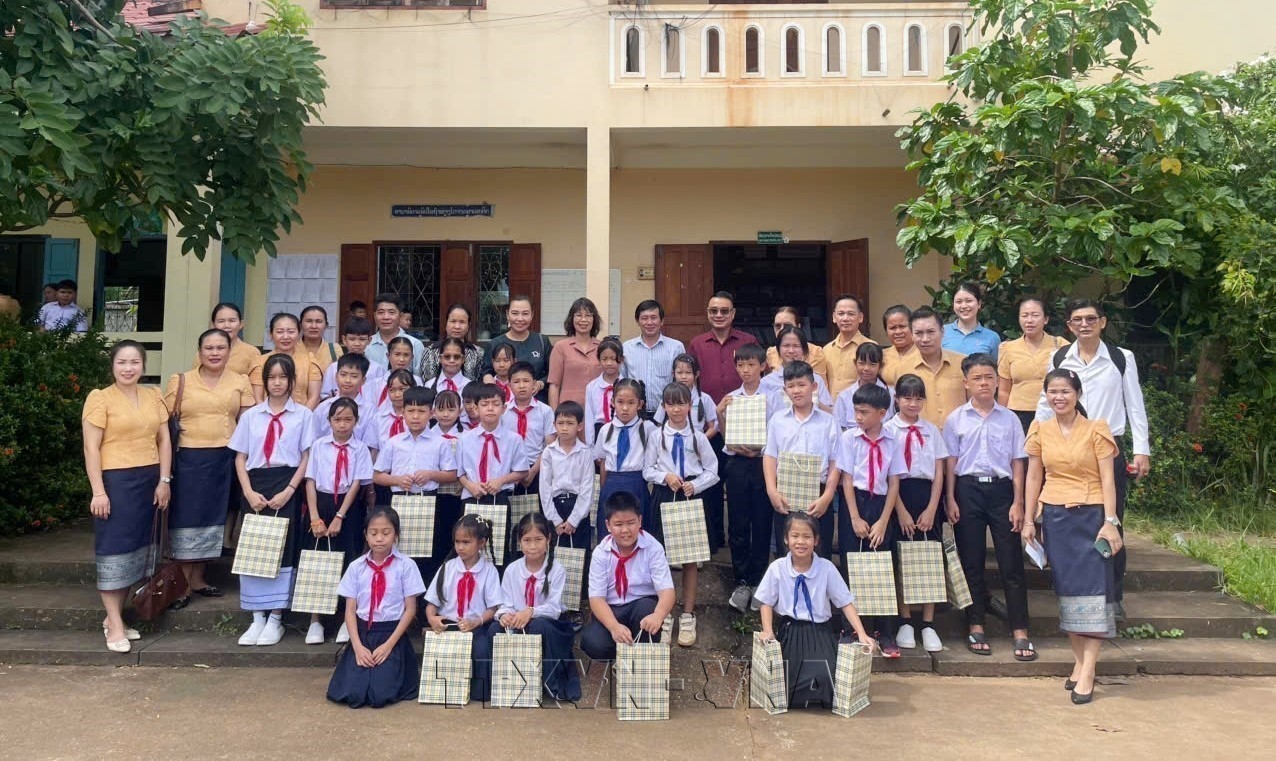
Delegates from the Vietnamese Consul General and agencies presents gifts to students of the Laos-Vietnam friendship school in Champasak. Photo: Published by VNA
The Politburo’s Resolution No. 23-NQ/TW, dated August 2, 2026, on OV affairs, continues to emphasise the preservation and promotion of the Vietnamese language and national cultural identity, with the aim of making the mother tongue a strong bond connecting generations of overseas Vietnamese with their homeland.
New impetus for preserving Vietnamese language
Building on the implementation of the project on the Day honouring Vietnamese language among OV communities for the 2023-2030 period, Resolution No. 23-NQ/TW calls for greater efforts to preserve and promote the Vietnamese language and national cultural identity, while encouraging OVs to serve as “cultural ambassadors” promoting Vietnam, its culture and people.
Le Thi Bich Huong, a Vietnamese language lecturer at the University of Turin and Ca’ Foscari University of Venice in Italy, said the resolution provides strong encouragement to overseas Vietnamese and demonstrates the Party and State’s attention to the community - an integral part of the Vietnamese nation and an important national resource.
The resolution’s long-term vision, which seeks both to strengthen ties between OVs and the homeland and mobilise the community’s resources, knowledge and cultural values, will help foster greater confidence among younger generations to remain connected with and contribute to Vietnam.
However, Huong noted that promoting Vietnamese in Italy faces numerous challenges, including competition from Asian languages such as Japanese, Chinese, Korean and Thai. She suggested that Vietnamese language promotion should be closely linked with the promotion of Vietnamese culture, history, people and the country’s dynamic development, making the language more attractive to international learners and young people of Vietnamese origin.
The resolution’s long-term vision, which seeks both to strengthen ties between OVs and the homeland and mobilise the community’s resources, knowledge and cultural values, will help foster greater confidence among younger generations to remain connected with and contribute to Vietnam.
However, Huong noted that promoting Vietnamese in Italy faces numerous challenges, including competition from Asian languages such as Japanese, Chinese, Korean and Thai. She suggested that Vietnamese language promotion should be closely linked with the promotion of Vietnamese culture, history, people and the country’s dynamic development, making the language more attractive to international learners and young people of Vietnamese origin.
Keeping Vietnamese language alive among young generations
Thach Ngoc Minh, head of the Vietnamese Language Programme at the Centre for Language Studies of the National University of Singapore, stressed that families play a particularly important role in maintaining the mother tongue. Parents should encourage children to communicate in Vietnamese at home and access Vietnamese books, films, broadcasts and digital content.
Thach Ngoc Minh, head of the Vietnamese Language Programme at the Centre for Language Studies of the National University of Singapore, stressed that families play a particularly important role in maintaining the mother tongue. Parents should encourage children to communicate in Vietnamese at home and access Vietnamese books, films, broadcasts and digital content.
He noted that an increasing number of Vietnamese-origin children born in Singapore are enrolling in Vietnamese classes so that they can communicate with their parents and especially their grandparents in Vietnam, reflecting continued and growing demand among younger generations.
Community activities and cultural festivals also provide opportunities for young people to use Vietnamese in real-life settings and strengthen their attachment to their homeland. At the same time, digital platforms and artificial intelligence (AI) are creating new tools for teaching and learning the language, from digital resources to educational games.
Ta Thuy Lien, head of the Liaison Board for Vietnamese People in Singapore, said the bond created by the Vietnamese language becomes stronger when it is associated with experiences and emotions connected to the homeland. Activities such as Mid-Autumn Festival celebrations, Homeland Spring programme and sports events have enabled young people to experience Vietnamese culture while using their mother tongue.
She also highlighted the potential of digital technology and AI to personalise Vietnamese language learning and make it more accessible. Responsible use of AI, she said, can turn the digital space into an effective environment for learning and preserving the Vietnamese languague.
From language classrooms and community activities to digital platforms, Vietnamese is being preserved through increasingly diverse approaches. More than a means of communication, the mother tongue carries memories, culture and affection for the homeland. Ensuring that Vietnamese remains naturally present in the daily lives of overseas Vietnamese is therefore an important way to nurture their lasting bond with the Fatherland./.
Community activities and cultural festivals also provide opportunities for young people to use Vietnamese in real-life settings and strengthen their attachment to their homeland. At the same time, digital platforms and artificial intelligence (AI) are creating new tools for teaching and learning the language, from digital resources to educational games.
Ta Thuy Lien, head of the Liaison Board for Vietnamese People in Singapore, said the bond created by the Vietnamese language becomes stronger when it is associated with experiences and emotions connected to the homeland. Activities such as Mid-Autumn Festival celebrations, Homeland Spring programme and sports events have enabled young people to experience Vietnamese culture while using their mother tongue.
She also highlighted the potential of digital technology and AI to personalise Vietnamese language learning and make it more accessible. Responsible use of AI, she said, can turn the digital space into an effective environment for learning and preserving the Vietnamese languague.
From language classrooms and community activities to digital platforms, Vietnamese is being preserved through increasingly diverse approaches. More than a means of communication, the mother tongue carries memories, culture and affection for the homeland. Ensuring that Vietnamese remains naturally present in the daily lives of overseas Vietnamese is therefore an important way to nurture their lasting bond with the Fatherland./.