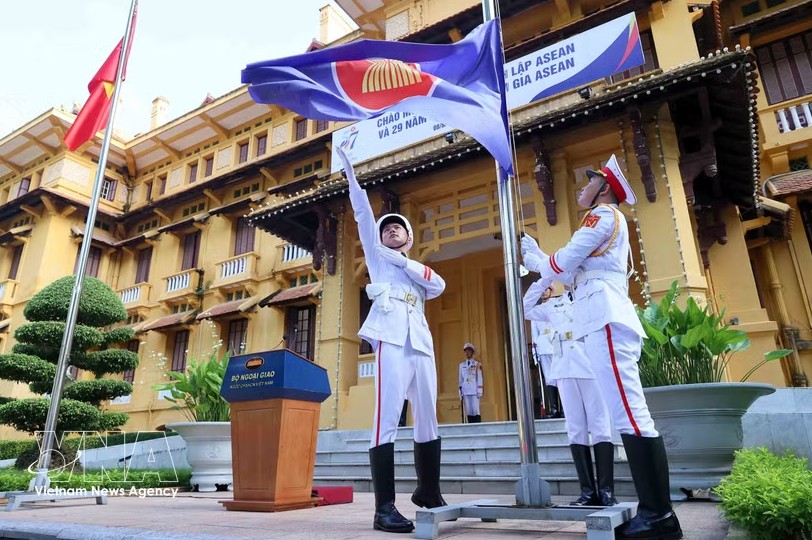
Flag-raising ceremony marking the 57th anniversary of the founding of the Association of Southeast Asian Nations (ASEAN), organised by the Vietnamese Ministry of Foreign Affairs in Hanoi on August 8, 2024. Photo: VNA
Speaking to Vietnam News Agency correspondents in Malaysia, the expert said Vietnam’s decision to organise the forum was highly timely, as the bloc is currently facing a range of interconnected challenges, from major-power competition, maritime tensions and supply chain disruptions to non-traditional issues such as climate change and technological transformation. In such an uncertain environment, the theme chosen by Vietnam serves as a strategic affirmation of the values ASEAN most urgently needs today: regional solidarity, stability and growth founded on the well-being of its people.
Collins noted that the emphasis on peace directly reflects one of the region’s foremost strategic concerns. Southeast Asia is currently one of the world’s most geopolitically complex regions, particularly in relation to developments in the East Sea and the spillover effects of other global flashpoints. In his view, Vietnam understands clearly that without a peaceful, stable and predictable environment, ASEAN’s economic development objectives will be difficult to achieve.
At the same time, the goal of prosperity is being pursued as the bloc seeks to reinforce its role as a dynamic growth centre amid the restructuring of global trade and investment flows. However, the Malaysian expert argued that such prosperity cannot be achieved through isolated national strategies. Rather, it requires stronger regional integration, ranging from resilient supply chains and digital integration to enhanced energy security.
Importantly, the principle of people-centred development adds political and social depth to the forum. It underscores that ASEAN is not merely a project of intergovernmental cooperation but must remain closely connected to the practical interests of its citizens through employment, education, healthcare and resilience to climate-related shocks.
According to Collins, the organisation of the AFF 2026 also reflects Vietnam’s foreign policy of independence, self-reliance, multilateralisation and diversification in a regional context. Through the forum, the nation continues to affirm its role as a proactive, active and responsible member of ASEAN.
The event, he said, reaffirms Vietnam’s commitment to ASEAN as the prioritised pillar of the regional architecture, with Vietnam enhancing its own standing through contributions to the bloc’s collective capacity and strength.
The forum’s agenda demonstrates efforts to link traditional foreign policy issues with emerging challenges such as artificial intelligence (AI) governance, urban development and Mekong subregional cooperation. This reflects an increasingly mature approach to regional diplomacy, one that not only addresses immediate concerns but also seeks to anticipate long-term trends.
The AFF also contributes to supporting Vietnam’s development vision while reinforcing Hanoi’s image as a responsible stakeholder capable of connecting ASEAN with global partners.
One of the most significant features of the AFF, the analyst noted, is Vietnam’s continued commitment to developing the forum into a reputable regional track-two dialogue mechanism. This helps provide ASEAN with a more flexible policy discussion platform where officials, academics and the business community can exchange views and propose new initiatives before they are considered through formal channels.
He stressed that the forum not only enhances Vietnam’s international standing but also strengthens ASEAN centrality in its relations with external partners. By proactively defining priorities in areas such as energy, digital transformation and sustainable growth, the bloc can bolster its strategic autonomy and improve its ability to adapt to changes in the international environment.
According to Collins, what Vietnam has done and continues to do reflects a long-term foreign policy vision that helps ASEAN not only adapt to the challenges of the times but also take a more active role in shaping its future position in the world./.
Collins noted that the emphasis on peace directly reflects one of the region’s foremost strategic concerns. Southeast Asia is currently one of the world’s most geopolitically complex regions, particularly in relation to developments in the East Sea and the spillover effects of other global flashpoints. In his view, Vietnam understands clearly that without a peaceful, stable and predictable environment, ASEAN’s economic development objectives will be difficult to achieve.
At the same time, the goal of prosperity is being pursued as the bloc seeks to reinforce its role as a dynamic growth centre amid the restructuring of global trade and investment flows. However, the Malaysian expert argued that such prosperity cannot be achieved through isolated national strategies. Rather, it requires stronger regional integration, ranging from resilient supply chains and digital integration to enhanced energy security.
Importantly, the principle of people-centred development adds political and social depth to the forum. It underscores that ASEAN is not merely a project of intergovernmental cooperation but must remain closely connected to the practical interests of its citizens through employment, education, healthcare and resilience to climate-related shocks.
According to Collins, the organisation of the AFF 2026 also reflects Vietnam’s foreign policy of independence, self-reliance, multilateralisation and diversification in a regional context. Through the forum, the nation continues to affirm its role as a proactive, active and responsible member of ASEAN.
The event, he said, reaffirms Vietnam’s commitment to ASEAN as the prioritised pillar of the regional architecture, with Vietnam enhancing its own standing through contributions to the bloc’s collective capacity and strength.
The forum’s agenda demonstrates efforts to link traditional foreign policy issues with emerging challenges such as artificial intelligence (AI) governance, urban development and Mekong subregional cooperation. This reflects an increasingly mature approach to regional diplomacy, one that not only addresses immediate concerns but also seeks to anticipate long-term trends.
The AFF also contributes to supporting Vietnam’s development vision while reinforcing Hanoi’s image as a responsible stakeholder capable of connecting ASEAN with global partners.
One of the most significant features of the AFF, the analyst noted, is Vietnam’s continued commitment to developing the forum into a reputable regional track-two dialogue mechanism. This helps provide ASEAN with a more flexible policy discussion platform where officials, academics and the business community can exchange views and propose new initiatives before they are considered through formal channels.
He stressed that the forum not only enhances Vietnam’s international standing but also strengthens ASEAN centrality in its relations with external partners. By proactively defining priorities in areas such as energy, digital transformation and sustainable growth, the bloc can bolster its strategic autonomy and improve its ability to adapt to changes in the international environment.
According to Collins, what Vietnam has done and continues to do reflects a long-term foreign policy vision that helps ASEAN not only adapt to the challenges of the times but also take a more active role in shaping its future position in the world./.