Over half a century after the war, the search for, recovery and identification of fallen soldiers continues across the country. Clues come from former battlefields, old records, personal belongings, family accounts and DNA analysis. Each may help restore a name to someone who gave their life for the country. The 500-day-and-night campaign brings these efforts together in a nationwide mission of remembrance.
At the Army Radio and Television Center at 165 Xa Dan Street in Dong Da Ward, Hanoi, the Finding Comrades program receives information, documents and personal belongings from families, veterans and witnesses. Every meeting, phone call or document may offer a new lead, from an old place name or a burial site recalled by a fellow soldier to a faded photograph or details of a soldier's unit and death.
These accounts help authorities cross-check information against existing records and databases. The campaign's hotline also connects search teams with families seeking their loved ones' burial sites. From June 15 to August 28, 2026, it received about 40,000 calls, including more than 13,000 inquiries from families and around 1,800 reports of burial locations. The figures reflect both the wealth of information still held by the public and the hopes of families who have waited decades for answers.
Another valuable source is the collection of records and personal belongings of wartime personnel who went south, preserved at the National Archives Center III. Personal papers, biographies, volunteer applications, letters and notebooks document their lives and may provide clues for identification. Each file and keepsake helps connect their wartime stories with search efforts today.
The search also extends to martyrs' cemeteries, where DNA samples are collected from graves containing unidentified remains. At Mai Dich Cemetery in Hanoi, teams carefully excavate graves, collect samples and record information under established procedures. The remains are handled with respect, while samples are coded, preserved and sent for analysis. Precision at every stage is essential to confirming identities.
DNA testing can establish biological relationships between remains and samples provided by relatives, but results depend on sample quality, reference data and other technical factors. When DNA evidence is inconclusive, records, personal belongings, witness accounts and historical information remain important.
In Vi Xuyen, Tuyen Quang province, where fierce battles were fought during the defense of the northern border, recovering fallen soldiers remains challenging. Rugged terrain, changing battlefield conditions and unexploded ordnance complicate search operations. Teams must ensure safety, clear explosives and verify information before locating suspected burial sites.
After decades, some locations can only be traced through accounts from former comrades, old maps or landmarks that have disappeared. Cross-checking these sources with field evidence is crucial to ensuring accurate identification. Each discovery may also provide new leads for further searches.
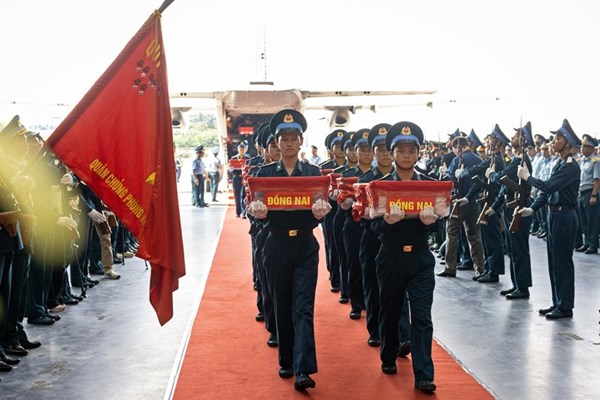
The campaign's work extends from battlefields to laboratories. On September 11, 2026, a military CASA-295 aircraft transported 13,563 samples of remains from Tan Son Nhat Airport to Gia Lam Airport in Hanoi. Packed in 144 specialized containers, they were handed over for DNA testing. Of these, 3,625 samples from Lam Dong province went to the Military Institute of Forensic Medicine, while those from Dong Nai and Tay Ninh were sent to the Vietnam Academy of Science and Technology.
At the Military Institute of Forensic Medicine, samples are received, preserved and processed under strict protocols. From record checks and coding to DNA extraction and analysis, every stage requires precision and affects the reliability of the results. Samples exposed to harsh environmental conditions for decades pose particular challenges.
DNA testing alone cannot identify every fallen soldier. Scientific findings must sometimes be combined with records, personal belongings, unit information and accounts of the circumstances surrounding a soldier's death. Close coordination among search teams, archives, information centers, forensic laboratories and families is therefore essential.
Running from March 15, 2026, to July 27, 2027, the campaign aims to accelerate the search, recovery and identification of fallen soldiers ahead of the 80th anniversary of War Invalids and Martyrs Day. Its ambitious targets require coordinated efforts from agencies, military units and localities. Behind the figures are soldiers who gave their lives, families still searching for their graves and comrades who have never forgotten those left behind.
From a family's phone call and an old archive file to a discovery in the mountains and a DNA test in the laboratory, every lead brings the search closer to its goal. Not every case can be resolved quickly, but each verified clue and recovered set of remains offers renewed hope.
The 500 days and nights are more than a campaign timeline. They represent a continuing commitment to honoring those who sacrificed their lives for the country and bringing them home to their families.