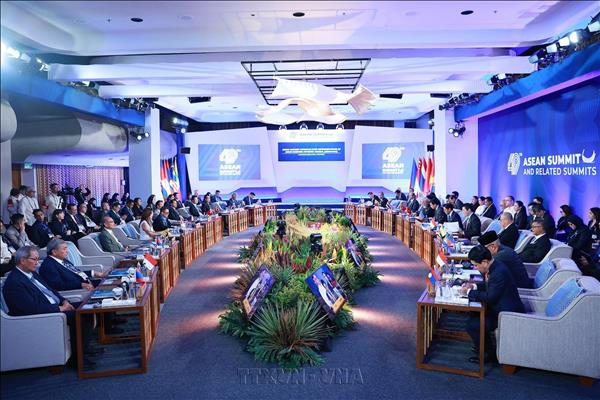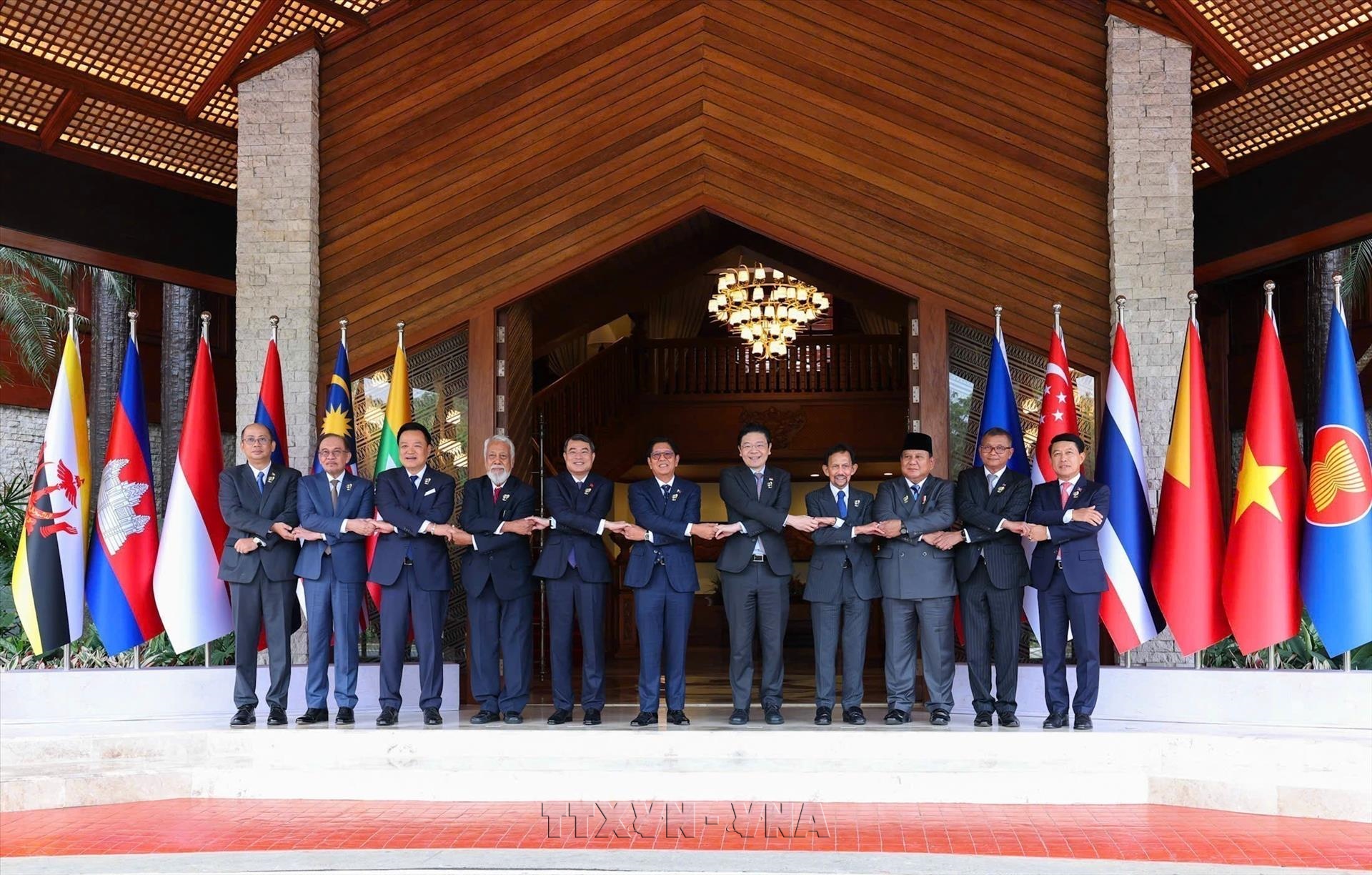
Prime Minister Le Minh Hung and other heads of delegation attend the retreat session of the 49th ASEAN Summit. Photo: VNA
Addressing the meeting, PM Hung stressed that ASEAN should take a more proactive role in shaping the regional strategic environment to safeguard peace, security and development. In this spirit, he put forward three proposals.
First, ASEAN should build trust and address differences through dialogue. Regarding the East Sea, he called on ASEAN member states to coordinate closely and work with China towards an effective and substantive code of conduct (COC) in the East Sea consistent with international law, particularly the 1982 United Nations Convention on the Law of the Sea (UNCLOS), helping turn the East Sea into a sea of peace, stability and prosperity. On Myanmar, he urged ASEAN to maintain and expand humanitarian assistance to its people while considering adjustments to its approach to enable more effective and substantive engagement with the country.
Second, ASEAN should proactively prevent and manage crises and respond to common challenges. The PM supported strengthening existing mechanisms to improve the bloc's capacity for rapid response to emergencies threatening regional peace and security. He affirmed Vietnam's readiness to work with other ASEAN countries to combat transnational crime, including online scams, cybercrime and human trafficking, while promoting safe and responsible artificial intelligence governance.
Third, ASEAN should take the lead in driving cooperation with partners, shifting from maintaining its centrality to actively shaping that role. The PM proposed that ASEAN develop a cooperation roadmap with partners, focusing on areas that deliver tangible benefits to people, including trade, investment, science and technology, innovation, strategic infrastructure and high-quality human resource development. He also called for maintaining balanced relations with partners and encouraging major powers to act responsibly and contribute to regional peace and shared prosperity.
ASEAN leaders focused their discussions on strengthening energy security cooperation and exchanged views on global developments and regional and international issues of shared concern.
They noted that the conflict in the Middle East continued to affect energy and food supplies and prices, directly impacting production and people's livelihoods. They agreed to step up coordinated responses, diversify supply sources and enhance regional energy connectivity, including through the early implementation of the ASEAN Petroleum Security Agreement (APSA) and the promotion of the ASEAN Power Grid (APG), to ensure stable energy supplies for people and businesses.
Amid rapid and profound global changes, the leaders reaffirmed their commitment to maintaining unity, strengthening cooperation, deepening economic integration, enhancing resilience, coordinating responses to crises, and expanding and deepening relations with partners.
They underscored the importance of upholding international law, the ASEAN Charter and the Treaty of Amity and Cooperation in Southeast Asia (TAC), while persistently resolving differences and disputes through peaceful means.
The leaders reaffirmed their common position and determination to fully and effectively implement the Declaration on the Conduct of Parties in the East Sea (DOC), while actively working towards an effective and substantive COC, consistent with international law, including the 1982 UNCLOS.
They also reaffirmed ASEAN's continued support for Myanmar in seeking a peaceful and sustainable solution owned and led by the country, based on the Five-Point Consensus./.