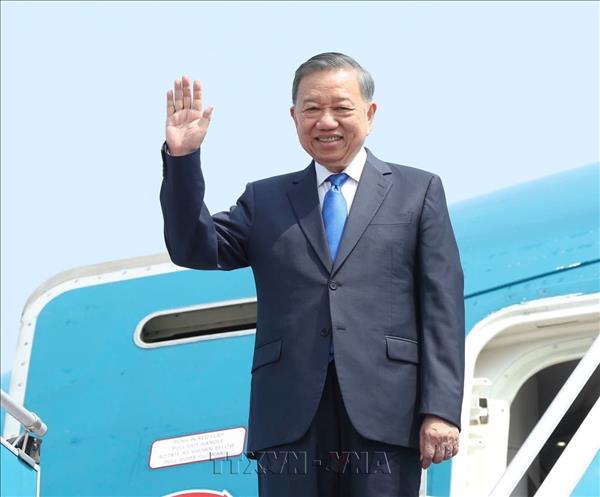
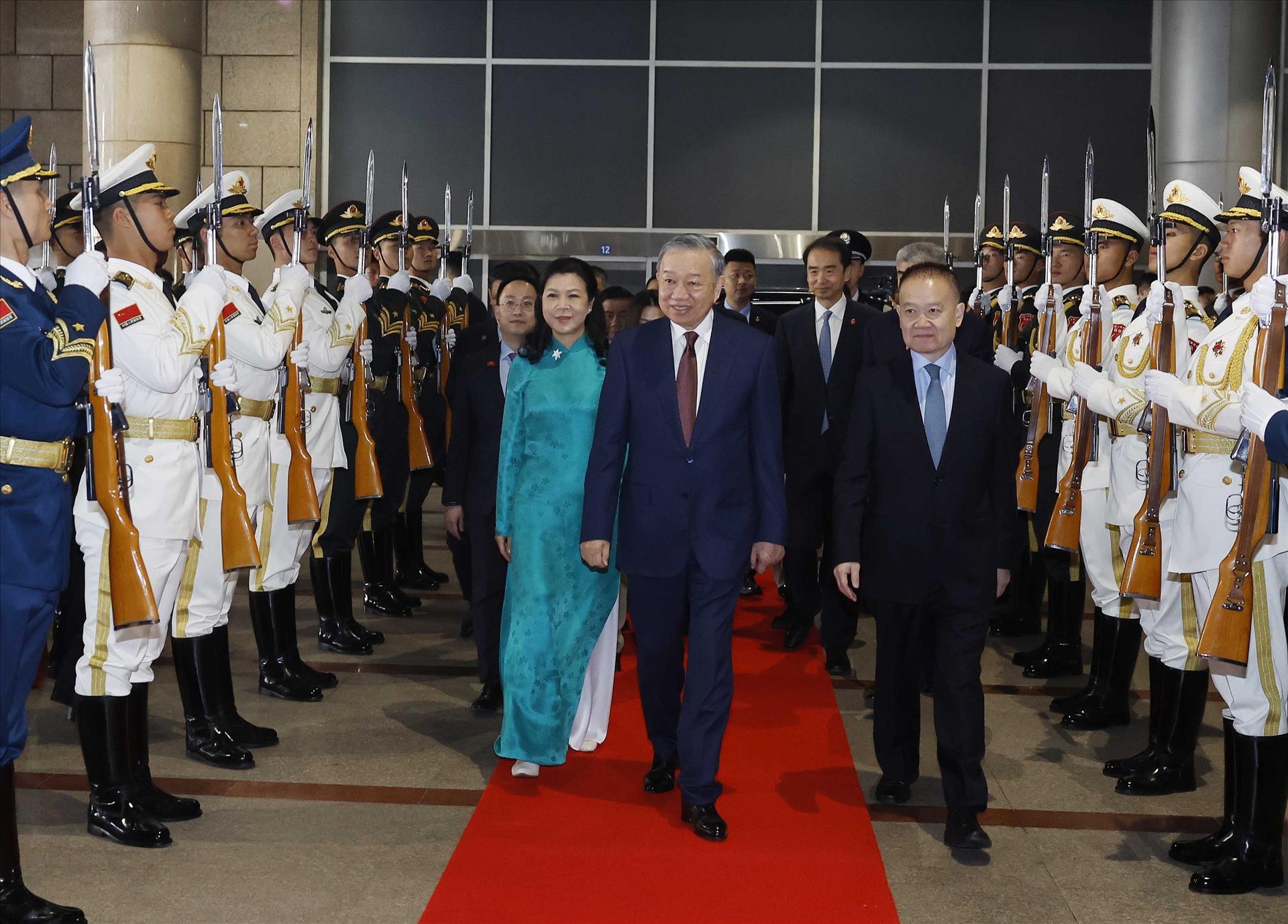
General Secretary of the Communist Party of Vietnam (CPV) Central Committee and President of Vietnam To Lam, his spouse and the high-ranking delegation of Vietnam departed Beijing on April 16 morning for a visit to Nanning city, continuing their state visit to China.
They travelled by high-speed train after concluding official activities in Beijing. Chinese officials accompanying the delegation included Liu Haixing, head of the International Department of the Communist Party of China Central Committee; Chen Zhou, deputy head of the same body; and Chinese Ambassador to Vietnam He Wei and his spouse.
At the station, Beijing Mayor Yin Yong and staff of the Vietnamese Embassy in China saw off the delegation.
During the journey, leaders of Chinese railway businesses briefed the Vietnamese leader on the rapid development of the local rail system. As of early 2026, China’s operational railway network has reached 165,000 km, including about 54,000 km of high-speed rail – the largest in the world, accounting for over 70% of the global total.
Since the launch of the medium- and long-term railway network plan in 2004, China has built a modern and extensive rail system connecting major urban centres, with rail access reaching 99% of cities with populations of over 200,000. More than 130 county-level localities are now connected by rail. The total network length has risen 2.4 times from 68,700 km in 2000.
Looking ahead to 2035, China aims to develop a high-quality transport network spanning around 700,000 km, including 200,000 km of railway lines that play a central role in linking county- and higher-level administrative units, border gates and key infrastructure hubs nationwide.
Expressing his impression of China’s high-speed rail achievements, General Secretary and President Lam noted that the system is not only the longest but also among the most widely utilised globally, with strong prospects for further expansion. He underscored the importance of enhancing bilateral cooperation in transport connectivity, particularly railways, to support green development and national growth.
Highlighting the significance of high-speed rail cooperation, he called on Chinese railway authorities and enterprises to share expertise, support technology transfer and participate in the development of key railway projects in Vietnam.
In a recent inspection of Vietnam – China railway cooperation progress in Lang Son province, the top leader of Vietnam affirmed that railway cooperation between the two countries represents both a demand and an opportunity. If effectively implemented, such cooperation will help reduce logistics costs and transport time, facilitate trade, boost border economic development, ease congestion at land border gates, and connect Vietnam to the broader Asia – Europe rail network, thereby strengthening regional linkages and enhancing the country’s role in Asian supply chains./.