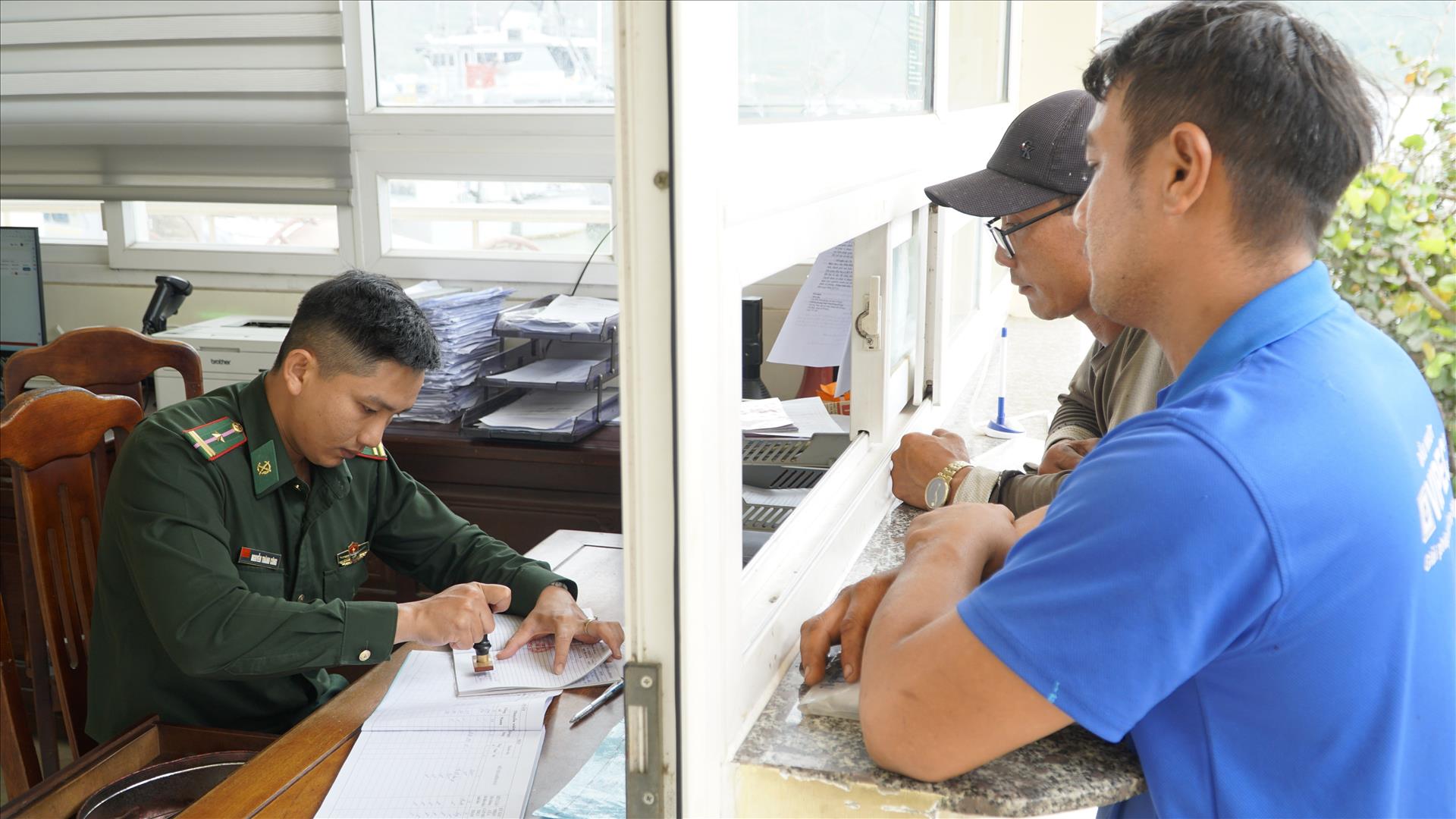
Fishermen complete departure procedures before setting sail. Photo: VNA
In early April 2026, fishing ports across the South-Central Coast were bustling with vessels returning from sea.
At Tam Quan fishing port, in Hoai Nhon ward, Gia Lai province, many boats coming back from Truong Sa and Hoang Sa were laden with catches.
Le Thanh Toan, 47, owner of four fishing vessels, said local fishermen have moved away from nomadic fishing towards fixed catching systems at sea. These structures, made from leaves and old fishing gear and anchored in place, create habitats that attract fish, which are harvested after several months. Each structure typically involves 4–10 boats, sometimes up to 20, working together in fishing, protection, and transport.
“This method saves fuel, reduces risks, and helps limit violations related to illegal, unreported and unregulated (IUU) fishing. Two of my boats recently caught nearly 45 tonnes of fish, earning close to 1 billion VND (37,976 USD),” he said.
In Vinh Loi fishing village in Gia Lai’s An Luong commune, advanced fishing technologies have improved livelihoods. Tran Van Lam, 54, who operates four vessels with capacities of 750–1,000 horsepower, has invested in Norwegian sonar systems worth between 6 billion and 10.5 billion VND.
“Thanks to advanced sonar, locating and identifying fish schools is highly accurate. Most trips are profitable, with catches ranging from dozens to hundreds of tonnes, bringing in billions of dong,” Lam said.
In Quang Tri province, young vessel owner Nguyen Van Hai has pioneered innovation by installing 280 modern LED lights instead of traditional fuel-intensive lighting systems.
“Previously, I used about 500 litres of fuel per night just to power the lights. With LED systems, fuel consumption has nearly halved,” Hai noted.
Meanwhile, Bui Van Quy has equipped his vessel with an autopilot system integrated with GPS and an electronic compass.
Before, a 200-nautical-mile journey took over 32 hours. Now, with autopilot following an optimal route, it takes around 27 hours, saving a significant amount of fuel each trip, Quy explained.
Meanwhile, at Tho Quang fishing port in Da Nang city, veteran fisherman Nguyen Tan Dung described the transformation of the local fishing sector. Today, vessels are equipped with fish finders, satellite positioning, digital fishing maps, and rapid communication systems, making offshore operations more efficient and safer.
Accelerating digital infrastructure, logistics
Nguyen Huu Vinh, Deputy Director of the Quang Tri Department of Agriculture and Environment, stressed the urgent need to restructure fishing methods, apply digital technologies, reduce costs, and ensure sustainable exploitation of marine resources. The province is focusing on three pillars: science and technology application, value-chain-based production, and occupational transition aligned with sustainability trends.
In Da Nang, more than 4,000 fishing vessels are being modernised, with digital transformation and science and technology at the core. Tho Quang fishing port serves as a digital hub for fisheries management in central Vietnam, where 100% of vessels are monitored, and catches are verified and traced via electronic logs and vessel monitoring systems.
The city is also preparing to launch a new wholesale fish market in May this year to stabilise prices and improve connections between fishermen and markets.
Beyond Tho Quang, Da Nang is continuing to digitalise infrastructure, expand anchorage areas, and develop a modern fisheries ecosystem across locations such as Hong Trieu, Tam Quang, Ky Ha, and Tam Tien.
According to Nguyen Huu Nghia, head of Gia Lai’s fisheries sub-department, the Hoai Nhon area has around 2,300 offshore vessels applying advanced tuna-handling techniques and piloting ultra-fine bubble (UFB) preservation technology, forming export-oriented value chains to Japan.
Gia Lai has launched a sustainable fisheries development plan for 2026–2030, with a vision to 2050 and funding exceeding 12 trillion VND. The plan focuses on restructuring fleets, developing smart logistics, and applying technologies such as AI, IoT, biofloc, and recirculating aquaculture systems, alongside internationally recognised standards like VietGAP, ASC, and BAP.
The province is also establishing concentrated seafood processing zones linked with logistics hubs in Tam Quan, Quy Nhon, and De Gi. The Tam Quan fishing port is set to be developed into a smart one using AI and automation, with ambitions to become a major tuna auction centre in Southeast Asia.
Across central coastal provinces, authorities have introduced policies to restructure fleets, reduce vessel numbers, and support fishermen in transitioning to more sustainable livelihoods. Provinces such as Dak Lak and Gia Lai have earmarked nearly 1 trillion VND to support occupational changes and decommission inefficient vessels, while others including Nghe An, Quang Tri, Hue, and Quang Ngai are implementing roadmaps to phase out thousands of underqualified boats./.