
Making news
Vietnam's leadership reshuffle to strengthen decision-making, elevate diplomatic standing: Japanese media
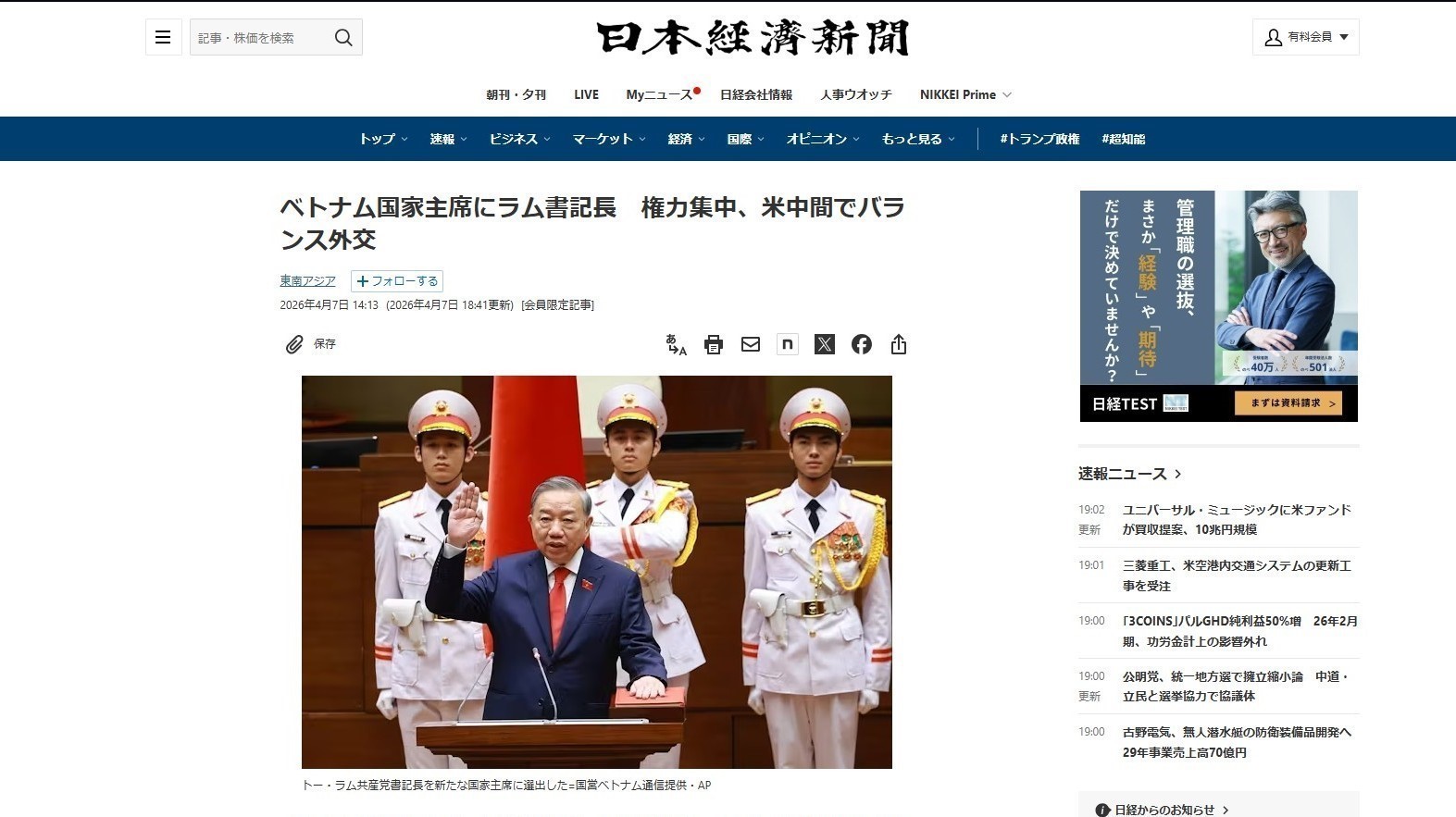
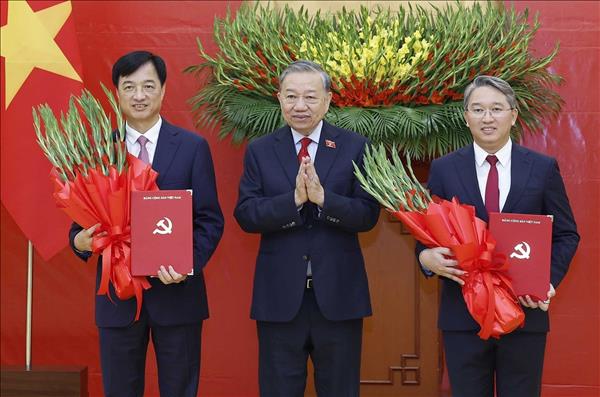
Vietnam’s decision to have Party General Secretary To Lam concurrently holds the position of State President is expected to speed up decision-making and strengthen the country’s diplomatic standing, enabling him to engage on an equal footing with other heads of state, according to Japanese media outlet Nikkei.
The Japanese newspaper on April 7 reported that Vietnam’s National Assembly had elected Party General Secretary To Lam as the country’s new State President with the absolute consensus from attending deputies. It noted that the consolidation of the roles of Party General Secretary and State President is likely to enhance Vietnam’s international profile in high-level diplomatic engagements.
Nikkei also referred to other key positions elected during the same parliamentary session. It said that new Prime Minister Le Minh Hung, who was former Governor of the State Bank of Vietnam (SBV), is the second youngest PM in history, after late PM Pham Van Dong.
Meanwhile, VietJo reported that before assuming senior Party leadership positions, PM Hung spent many years working at the SBV. In 2016, he became the youngest central bank governor in the country’s history.
According to VietJo, during his tenure from April 2016 to October 2020, he achieved notable results in flexibly governing the monetary policy, stabilising exchange rates, curbing inflation and, particularly, addressing non-performing loans in the banking system. In addition, by lowering interest rates and promoting capital flows into priority sectors such as production and business, he supported the economy and laid the foundation for enterprises to grow during a recent period of challenges.
Japanese media also pointed to expectations surrounding the new leadership as well as challenges facing Vietnam’s economy.
Nikkei noted that Vietnam is striving to reduce its heavy dependence on foreign direct investment (FDI). Developing domestic enterprises in high-tech sectors such as semiconductors is seen as increasingly important. Large Vietnamese conglomerates, including Vingroup and Viettel, are expected to play a central role in strengthening domestic capacity and reducing reliance on foreign capital.
Nikkei observed that Vietnam is projected to exit its “golden population” phase in the latter half of the 2030s. Against this backdrop, Party General Secretary and State President To Lam is promoting a shift from a labour-intensive growth model toward higher value-added sectors such as technology and branding.
Regarding foreign policy orientation, Nikkei said that Party General Secretary and State President To Lam is pursuing a balanced foreign policy approach among major powers.
By carefully preserving its position as not aligned with any bloc, Vietnam has signed many free trade agreements with countries and regions around the world, helping to attract foreign investment, Nikkei said, stressing that diplomatic success will have a direct impact on economic growth.
Regarding Vietnam – Japan relations, Nikkei said Japan also needs to further strengthen ties with Vietnam’s new leadership. With PM Le Minh Hung viewed as having a strong understanding of Japan, Japan's public opinion expects that Vietnam’s new PM will serve as a factor in further advancing bilateral relations in the time to come./.