
Vietnam’s ongoing efforts to streamline its political apparatus and the dynamism of its economy are creating a solid prerequisite for the country to enter the era of the nation's rise, Cuban Ambassador to Vietnam Rogelio Polanco Fuentes has said.
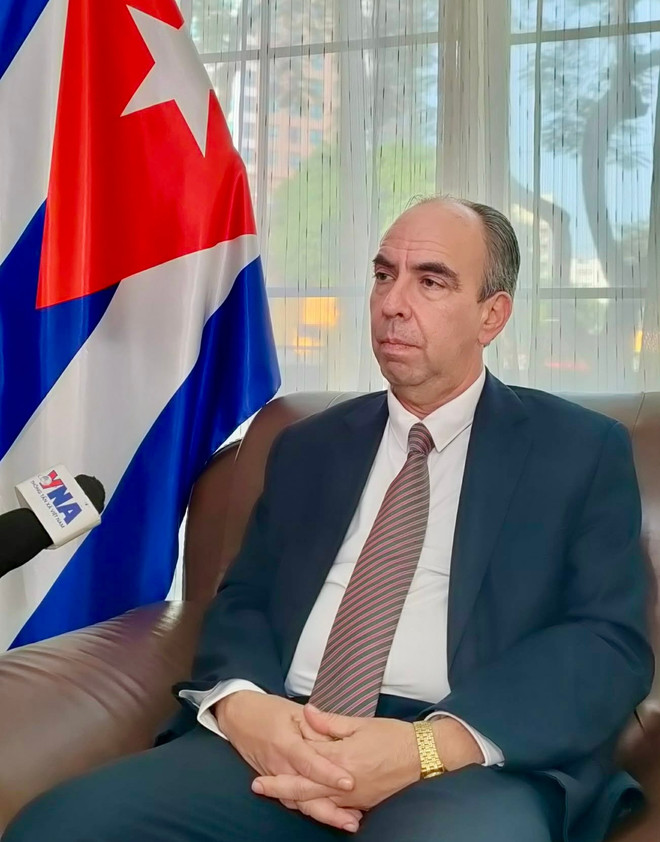
Speaking to the Vietnam News Agency (VNA) in a recent interview, Ambassador Fuentes shared his perspectives on Vietnam’s major milestones in 2025, highlighting the significance of institutional reform, economic achievements, the upcoming 14th National Congress of the Communist Party of Vietnam (CPV), and the prospects for Vietnam – Cuba strategic cooperation.
According to the Cuban diplomat, Vietnam’s drive to reorganise and streamline its political system has played a key role in enhancing the effectiveness and efficiency of governance over the past year.
He expressed admiration for Vietnam’s new development achievements, noting that the robust growth in foreign trade activities and foreign investment attraction have demonstrated the Vietnamese Party and State's determination to restructure the production model towards an economy based on innovation, digital transformation and sustainable development. He also voiced strong agreement with Vietnam’s view that the private sector constitutes a crucial driving force for national development.
Beyond economic attainments, Fuentes spoke highly of Vietnam’s social development achievements which, he said, are clearly reflected in social welfare policies. Among the most notable examples is the implementation of a roadmap to waive tuition fees for students from public preschools through high schools, along with the prioritisation of preventive health care and community-based health services.
In his view, these policies represent ideal preparations ahead of the 14th National Congress of the CPV, a strategic milestone whose documents are being drafted on the basis of extensive public consultation. The congress will also review 40 years of the Doi moi (Renewal) process and 15 years of implementing the Platform for National Construction in the transitional period towards socialism (supplemented and developed in 2011).
The ambassador expressed confidence that the 14th National Party Congress will define a strategic roadmap enabling Vietnam to become a developing country with upper-middle income by 2030, and a developed, high-income country with a socialist orientation by 2045.
Turning to bilateral relations, he affirmed that the Vietnam – Cuba friendship is now at a mature stage of development. The fraternal solidarity between the two nations, built on a special and exemplary relationship nurtured by President Ho Chi Minh and Commander-in-Chief Fidel Castro, and based on mutual support during the most challenging periods in history, has gained fresh momentum following the recent high-level visits. These include CPV General Secretary To Lam’s visit to Cuba and the trip to Vietnam by First Secretary of the Communist Party of Cuba and President of Cuba Miguel Diaz-Canel Bermudez.
The two countries are now working towards a more effective, substantive, and sustainable agenda for economic cooperation, he noted.
Fuentes said they are focusing on three priority areas of bilateral cooperation. The first is food production, through Vietnamese investment projects in Cuba, notably rice cultivation projects applying new technologies to help strengthen Cuba’s food sovereignty and food security. The second is biotechnology, marked by a joint venture at the Hoa Lac Hi-Tech Park to produce Cuban pharmaceuticals directly in Vietnam, serving domestic healthcare needs and exports to Southeast Asia. The third is energy, with Vietnamese enterprises actively deploying solar power complexes in Cuba to help address electricity shortages through renewable energy sources.
The ambassador added that the implementation of the Vietnam – Cuba Trade Agreement, which offers preferential tariff rates close to 0%, has generated new momentum for businesses of both countries to further deepen trade exchanges, in a manner commensurate with the 65-year tradition of steadfast, loyal, and iron-clad friendship between the two peoples./.