
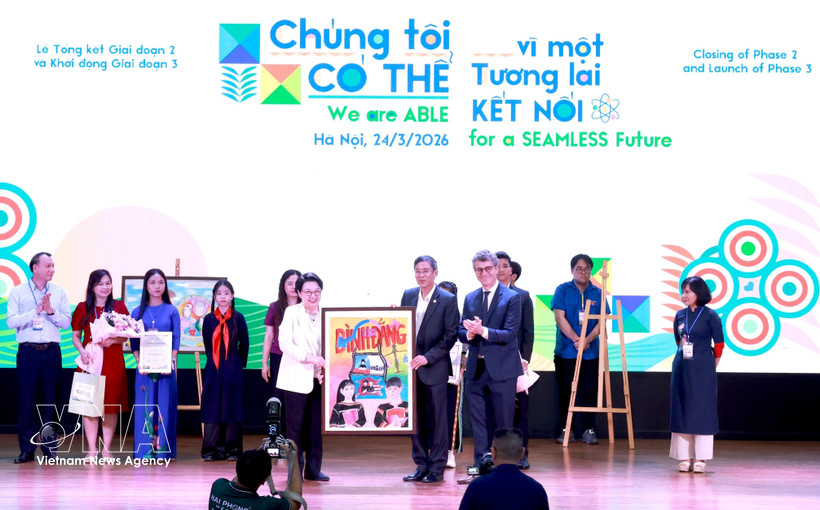
The third phase of a project promoting STEAM education linked with gender equality in Vietnam was officially launched in Hanoi on March 24, marking a renewed push to expand inclusive, future-ready learning models for students nationwide.
Jointly organised by UNESCO, the Ministry of Education and Training, and CJ Group, the event also reviewed the second phase of the project and launched its third phase. It highlighted progress made in integrating STEAM—Science, Technology, Engineering, Arts and Mathematics—into education, while advancing gender equality.
Launched in 2019, the “We Are ABLE” initiative aims to promote gender equality, support girls’ education, and foster safe and inclusive learning environments. During its second phase from 2023 to 2025, the project reached more than 8,000 students and their families in the provinces of Cao Bang, Vinh Long, and Khanh Hoa. It also enhanced the capacity of over 650 teachers and mobilised 300 youth leaders.
Speaking at the event, Vu Minh Duc, Director General of the Department of Teachers and Education Managers under the Ministry of Education and Training, highly valued the the project’s impact, noting that its first two phases had delivered tangible results in strengthening teachers’ and education managers’ capacity and promoting gender equality.
Gender-related content should be more systematically integrated into teacher training institutions to support the implementation of the National Strategy on Gender Equality for 2021–2030, he said.
Building on these achievements, the third phase, scheduled to run for 36 months from 2026 to 2029, has been launched under the theme “We are able for a seamless future”, focusing on learning and leading through STEAM education.
The new phase aims to address structural barriers and support students, particularly girls and those from ethnic minority groups in developing creativity, problem-solving skills, and competencies in STEAM fields. It is expected to directly benefit around 6,000 students, including 3,000 girls, while also strengthening the capacity of more than 100 teachers and counsellors.
UNESCO Representative to Vietnam Jonathan Wallace Baker stressed that promoting gender equality in and through education remains one of UNESCO’s core priorities. He said when girls are given meaningful opportunities to develop skills, confidence, and leadership capacity for the future, through initiatives such as STEAM education, they can unlock their full potential and contribute to the socio-economic development of their communities.
He added that through the “We Are ABLE” project, UNESCO is working alongside Vietnam to build a learning environment where every student can innovate and take the lead in shaping the future.
From the sponsor’s perspective, Heekyung Jo Min, Executive Vice President of Corporate Social Responsibility (CSR) at CJ Group, reaffirmed the company’s commitment to the project in its third phase. She highlighted efforts to expand access to quality learning opportunities and empower girls and ethnic minority students with the skills and confidence needed to succeed, particularly through STEAM education.
With women currently accounting for only about 37% of the STEM workforce in Vietnam, the initiative plays an important role in narrowing the gender gap.
The project directly contributes to Vietnam’s education priorities as well as the United Nations’ Sustainable Development Goals on Quality Education (SDG 4) and Gender Equality (SDG 5)./.