
Making news
Stepping up diplomacy, int’l integration is shared mission of entire Party, people, armed forces: FM
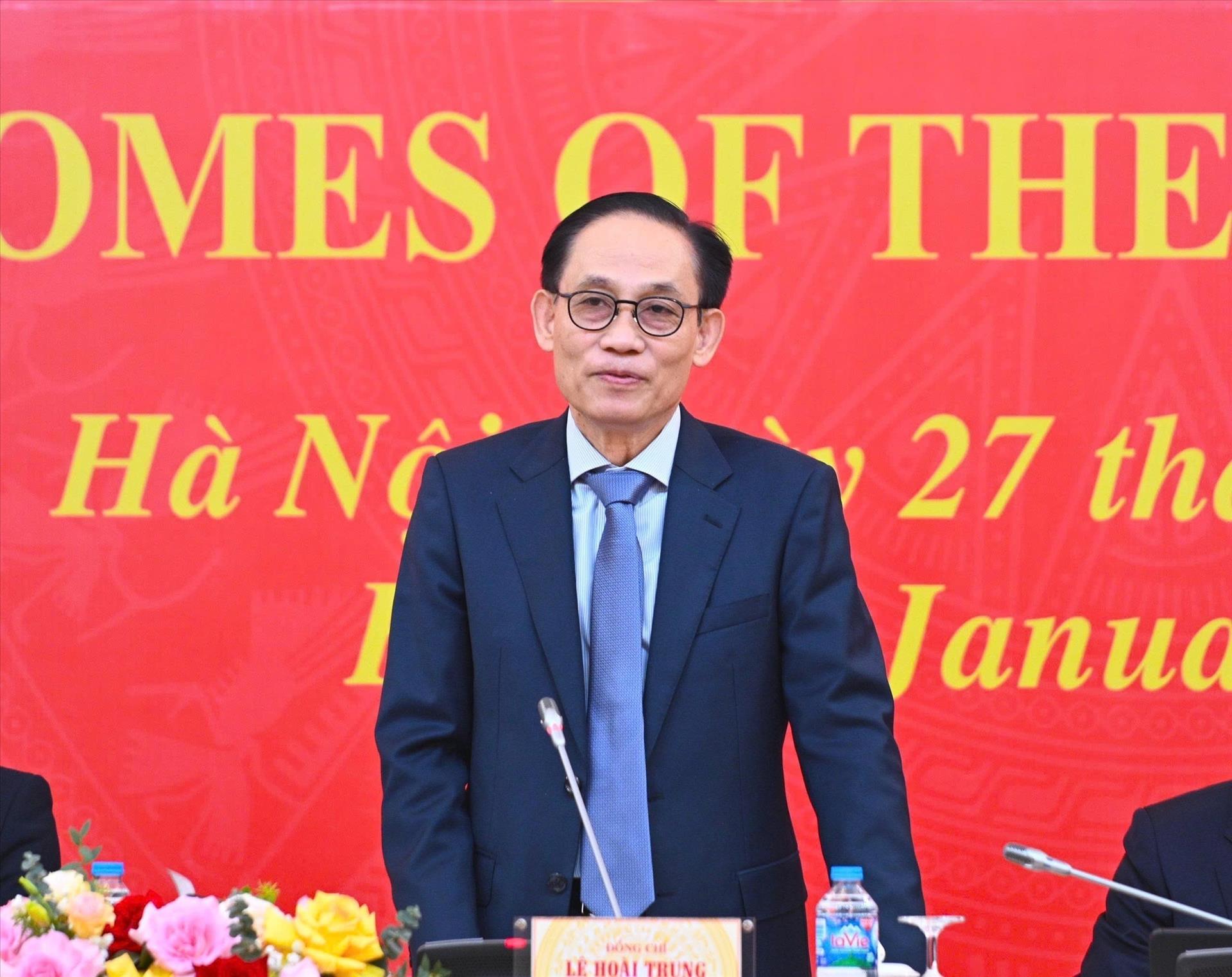
Advancing diplomacy and international integration is not the task of specialised external-affairs bodies alone nor of the Ministry of Foreign Affairs in isolation, but a shared cause of the entire Party, people and armed forces, involving the whole political system, Politburo member and Minister of Foreign Affairs Le Hoai Trung has affirmed.
Granting an interview to the press reviewing Vietnam’s diplomatic work in 2025 and outlining priorities for the time ahead, with particular emphasis on the “mission” assigned to foreign affairs by the 14th National Party Congress and by Politburo Resolution No. 59-NQ/TW on international integration in the new context, the minister noted that for the first time, foreign affairs was explicitly defined as a “critical and regular” field, alongside defence and security.
According to Trung, “critical and regular” denotes work of paramount importance, directly linked to the nation’s survival, security and prosperity, rooted in the long history of national construction and defence, and carried out continuously across all revolutionary periods. In the current era, it contributes directly to the successful fulfilment of the two strategic tasks of building and safeguarding the socialist Fatherland.
Meeting the demands of the new era requires diplomacy to remain under the Party’s direct and comprehensive leadership, the State’s unified management, and the proactive engagement of ministries, sectors, localities, citizens and enterprises, with the Ministry of Foreign Affairs serving as the core coordinating and advisory body.
In line with the guidance of Party General Secretary To Lam on elevating Vietnam’s comprehensive foreign strategy to a new level, the diplomatic sector will focus on three major orientations: safeguarding a peaceful and stable environment in close coordination with defence, security and other sectors; mobilising external resources, especially through economic and technology diplomacy, to serve socio-economic development and long-term national goals; and enhancing the Party’s and the country’s international standing, enabling Vietnam to play a more prominent role in global politics, the world economy and human civilisation.
Regarding the implementation of Resolution No. 59, the minister said the resolution reaffirms integration not only as a development driver but as a leading means of achieving national strategic objectives. He outlined four breakthrough groups of solutions for the period ahead.
First, there should be a continued shift in mindset and action under stronger Party leadership, moving from a passive “recipient” to an active “contributor”, from “deep integration” to “full integration”, and from the posture of a latecomer to that of a pioneer in emerging fields. This new thinking has been translated into practice, notably through the Government’s Action Programme to implement Resolution No. 59.
Second, to meet increasingly demanding development requirements, special mechanisms have been introduced. Notably, the National Assembly’s Resolution No. 250/2025/QH15, adopted in December 2025, created breakthrough arrangements to remove institutional, policy and resource bottlenecks to integration. The Ministry of Foreign Affairs and relevant agencies are finalising guiding decrees for issuance in the first quarter of 2026, enabling more effective integration at both domestic and international levels, including the mobilisation of high-quality human resources.
Fourth, effective integration requires a strong “culture of implementation”, with commitments matched by concrete action and follow-through. This entails prioritising substance and feasibility in negotiating and implementing international commitments, alongside timely domestic institutional and policy reform.
phục vụ phát triển làm trọng tâm, lấy doanh nghiệp và người dân là chủ thể, đổi mới và nâng cao hiệu quả công tác ngoại giao văn hóa và thông tin đối ngoại.
For the goal of building a comprehensive, modern and professional diplomatic service, Trung said the ministry is focusing on strengthening Party building and discipline, modernising management through digital transformation and data systems, developing a contingent of officials combining integrity, capability and dedication, and promoting synergy among political, economic, cultural, defence and security diplomacy, with economic diplomacy for development at the core and citizens and enterprises as central actors.
Reviewing diplomatic achievements in 2025, the diplomat described the year as one of exceptional global volatility and uncertainty. Against this backdrop, Vietnam successfully seized opportunities, addressed challenges and helped shape a new external environment for entering a new era. Diplomacy at the high level was particularly active, with relations upgraded with 17 partners, bringing the total number of comprehensive or higher-level partnerships to 42. Nearly 350 cooperation agreements were signed, 2.5 times more than in 2024, underscoring a focus on substance and effectiveness.
Economic diplomacy played a pioneering role in supporting the national growth target, expanding markets, attracting investment and integrating Vietnam more deeply into regional and global supply chains. Science and technology diplomacy emerged as a spearhead, focusing on innovation, digital transformation and green transition, contributing to realising 11 strategic technology fields.
Cultural diplomacy, the minister noted, significantly boosted Vietnam’s soft power, with seven new UNESCO-recognised titles in 2025, raising the total to 77 - well above the 2030 target. People-to-people diplomacy and citizen protection efforts were strengthened, while engagement with overseas Vietnamese communities generated record remittance inflows, becoming an important development resource.
Looking ahead, in line with the Politburo’s Resolution No. 80-NQ/TW on cultural development, cultural diplomacy will continue to innovate in thinking, content and methods; deepen integration in cultural forums; leverage digital transformation and strategic communications; and invest in human resources, particularly at overseas missions. These efforts, Trung said, will help project Vietnam as a culturally rich, humane and responsible nation contributing actively to global civilisation./.