
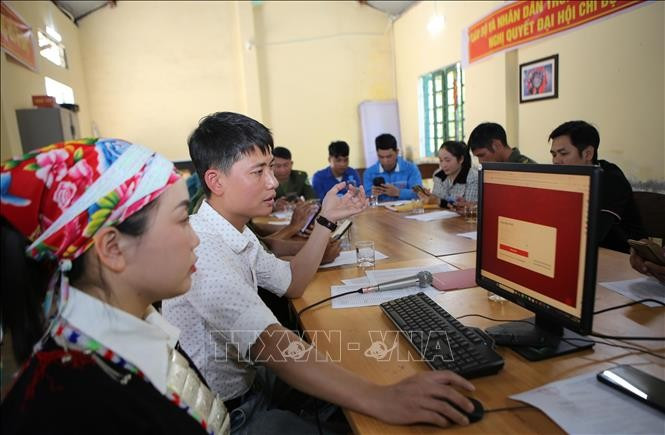
Many effective digital and knowledge-based models have been deployed simultaneously in remote and mountainous areas of Lao Cai province, marking an important step in promoting digital transformation among local communities and supporting the achievement of socio-economic development targets.
“Digital hamlets” in Bat Xat
The mountainous border commune of Bat Xat has emerged as a bright spot of digital transformation in Lao Cai with the successful implementation and expansion of the “digital hamlet” model. The initiative has significantly improved access to administrative procedures and strengthened the leadership and management capacity of the commune and hamlet authorities.
Suoi Chai village is the newest locality in Bat Xat applying the “digital hamlet” model, supporting residents with online administrative procedures, guiding the use of chip-based ID cards and digital services, implementing electronic Party member handbooks, conducting virtual party meetings, and holding online gatherings.
The implementation of the Politburo's Resolution No. 57 on breakthroughs in science, technology development, innovation, and national digital transformation in Bat Xat’s highland villages owes much to teachers, key members of the community digital technology teams.
Ha Thi Ben, Rector of Phin Ngan Kindergarten in the commune, said the school has nine satellite campuses, each with a teacher in charge of IT who guides village officials, Party members, and residents in completing administrative procedures and participating in online meetings.
Vu Hong Phuong, Standing Vice Secretary of the Bat Xat commune Party Committee, highlighted the significance of providing digital knowledge to residents in remote and ethnic minority areas, saying that this helps narrow the digital divide and ensures no one is left behind.
The model has already proven highly effective, he said, adding that in 2026, Bat Xat plans to roll out the “digital hamlet” model to all villages and develop a local team of residents skilled in using technology to support one another.
Digital transformation serves as economic leverage
The rapid digital transformation has encouraged farmers in Lao Cai to adopt information technology, social media, and e-commerce in production and business activities, generating a stable source of income.
Transitioning from traditional methods, many farmers in Lao Cai have learned to use smartphones to take photos and videos to showcase their products, connect with markets, and sell local farm produce on e-commerce platforms, building their brand and expanding their customer base.
Lo Din Phung in Muong Khuong commune, who currently harvests 4,000 tangerine trees, has leveraged online platforms like Facebook, Zalo, and e-commerce sites to promote and sell their produce at a stable average price of 20,000–25,000 VND per kilogramme.
She said she learned how to livestream, take photos, and write product descriptions - skills she had never considered before. She emphasised that for residents, this is not just “selling online” but a first step toward a digital economy.
Muong Khuong’s tangerines are now sold in many provinces and cities nationwide through e-commerce platforms, social media, and modern distribution channels.
According to the provincial Steering Committee for Science, Technology, Innovation, and Digital Transformation, Lao Cai completed all 167 tasks assigned in 2025. With this achievement, the province ranks among the highest in the country in fulfilling directives related to Resolution No.57.
In the future, the area will focus on building a digital economy that leverages local strengths, especially in digital agriculture, digital tourism, e-commerce, and cross-border logistics. It will also invest in digital infrastructure, data, and shared platforms, while fostering innovative human resources./.