
Making news
President Lee Jae Myung’s visit to align visions, shape long-term Vietnam–RoK cooperation: Ambassador
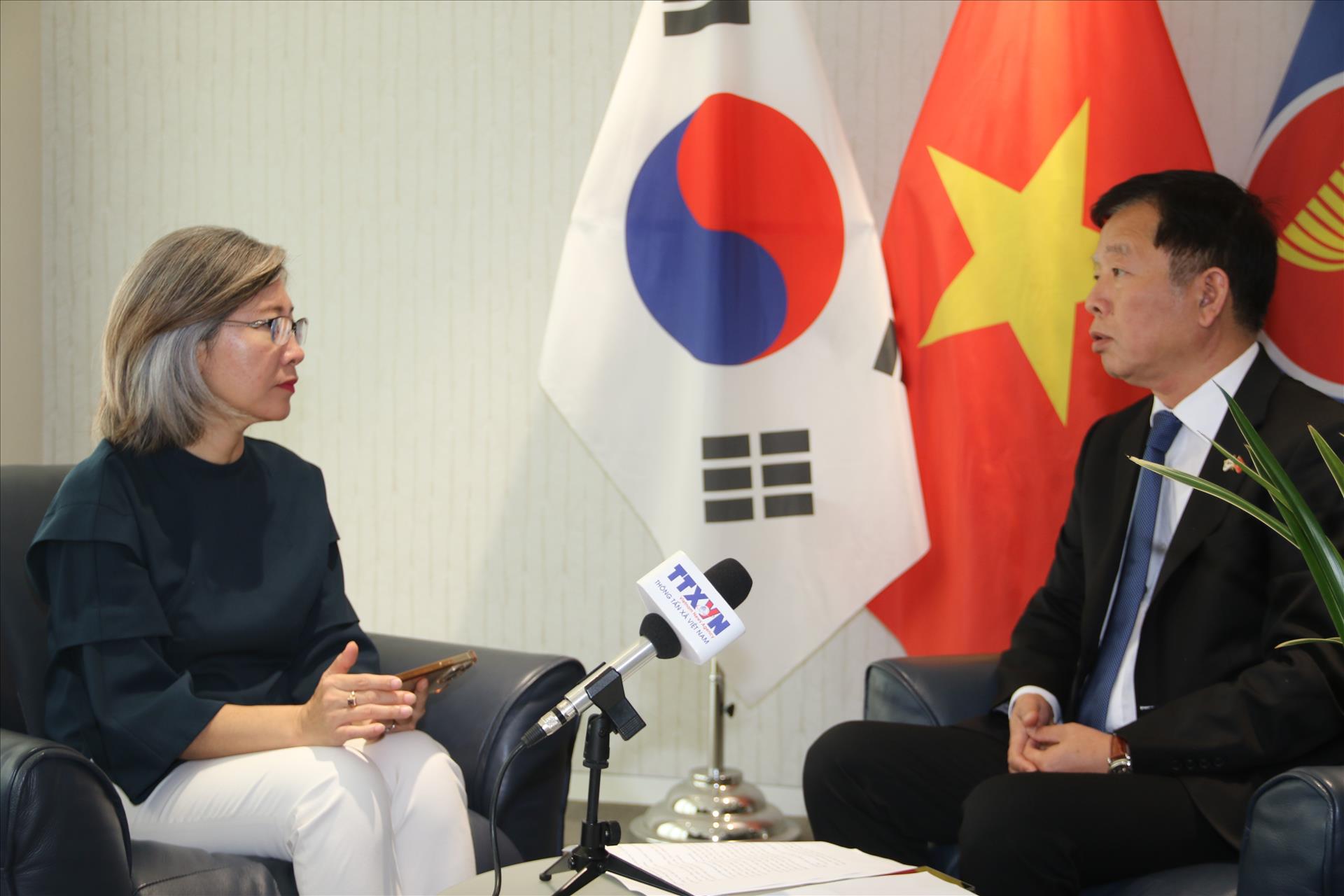
The visit will be made at the invitation of General Secretary of the Communist Party of Vietnam Central Committee and State President To Lam and his spouse.
Ho said that it takes place at a time when bilateral relations are at their most advanced stage, following the elevation to a Comprehensive Strategic Partnership in 2022. He noted that Vietnam has recently consolidated its key leadership after the 14th National Party Congress, ushering in a new development phase with long-term strategic orientations.
In that context, President Lee’s selection of Vietnam as an early destination for a state visit was seen as carrying both political and symbolic importance, reflecting the country’s high regard for Vietnam and the growing level of trust and strategic prioritisation in bilateral ties.
The RoK remains Vietnam’s largest foreign investor, with cumulative registered capital exceeding 90 billion USD, and one of its leading trading partners, with two-way trade estimated at around 88 billion USD in 2025, up 8% year-on-year.
This visit will provide an opportunity for the two countries to align their development strategies, shifting relations from breadth to depth and from traditional cooperation to strategic collaboration in high technology, innovation and economic security. The spirit of the new phase, the ambassador suggested, could be broadly characterised by higher trust, deeper cooperation and stronger, more sustainable cohesion.
Regarding strategic priorities during the RoK leader’s trip, Ho indicated that leaders of the two countries are likely to focus on three main directions. These include upgrading economic cooperation toward greater quality, balance and sustainability, with a view to raising bilateral trade to 100 billion USD and eventually 150 billion USD by 2030; strengthening linkages in strategic supply chains, particularly in semiconductors, digital technologies, data, batteries and clean energy; and enhancing synergies among investment, innovation and human resources development to elevate Vietnam’s position in global value chains and open new opportunities for Korean enterprises.
He further highlighted that science and technology cooperation is expected to serve as a central driver, with priorities including joint research and development, technology transfer and capacity building in areas such as artificial intelligence, semiconductors, energy and smart infrastructure.
On people-to-people exchanges, the diplomat underscored that these constitute the most sustainable foundation of bilateral relations. With approximately 350,000 Vietnamese nationals residing in the RoK and a large Korean community in Vietnam, a dense and substantive network of social connections has taken shape. He noted that as cooperation increasingly shifts toward high-tech sectors, human capital will play a decisive role, and both countries should prioritise education and training, particularly in key fields such as AI, semiconductors, energy and logistics. Cultural cooperation, he added, continues to function as an important “soft bridge,” strengthening mutual understanding and trust.
Looking at regional cooperation, Ambassador Ho stated that Vietnam and the RoK share converging interests in maintaining peace, stability and development. He suggested both sides enhance coordination based on respect for ASEAN centrality while advancing initiatives aligned with the ASEAN Outlook on the Indo-Pacific. This can include joint projects in infrastructure connectivity, digital transformation, clean energy and resilient supply chains, as well as closer coordination in mechanisms such as ASEAN+3, the East Asia Summit and the ASEAN Regional Forum.
He concluded that the two countries are well positioned to contribute to shaping an open, inclusive and rules-based regional architecture, thereby supporting not only their respective national interests but also broader regional stability and prosperity./.