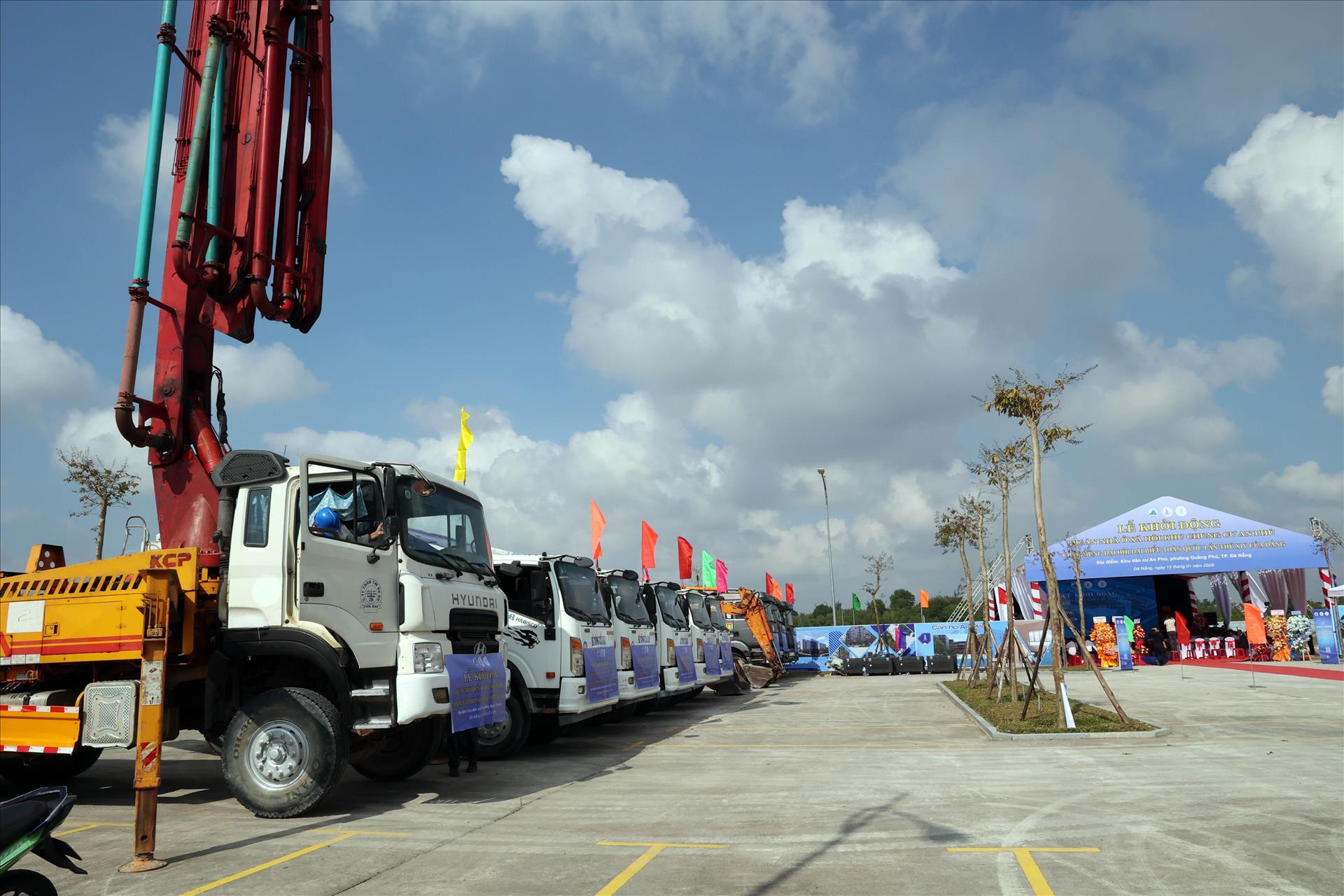
According to Decision No. 338/QD-TTg dated April 3, 2023, the Government leader approved the scheme on investing in the construction of at least one million social housing apartments for low-income earners and workers in industrial parks during the 2021-2030 period.
The Ministry of Construction noted that 2025 marked a clear step forward in social housing development, with more than 103,000 units completed nationwide, exceeding the annual plan by 3%. However, significant disparities in implementation progress among localities remain, underscoring the need for stronger and more decisive management to realise the one-million-home target.
A report prepared for the fifth meeting of the central steering committee on housing policy and the real estate market showed that, to date, 698 social housing projects are under implementation nationwide, with a total scale of 657,441 units. Of these, 193 projects have been completed, providing 169,643 units; 200 projects have broken ground with a combined scale of 133,611 units; and 305 projects have been approved in principle, equivalent to 354,187 units.
Overall, projects that have been completed, are under construction, or have received investment approval account for around 62% of the target of 1,062,200 social housing units to be built by 2030.
In 2025, 20 localities met or exceeded their assigned targets, with several major cities playing a leading role. Hanoi completed 5,158 units, surpassing its target by 10%, while Ho Chi Minh City fulfilled its quota of 13,040 units. Hai Phong achieved 123% of its target and Bac Ninh 120%. Several localities recorded particularly high levels of overperformance, including Thai Nguyen (390%), Nghe An (175%), Phu Tho (154%), Hung Yen (137%) and Son La (204%).
However, 11 localities failed to meet their 2025 targets, mainly in mountainous areas, the Central Highlands and the Mekong Delta. The wide disparities among localities reflect differences in land availability, project implementation capacity, access to capital and the level of attention given by local authorities to housing welfare policies.
In addition to localities, several central ministries and agencies have actively participated in the programme. The Ministry of Public Security has launched 11 housing projects for armed forces personnel, with a total of 10,105 units, far exceeding its assigned target. The Ministry of National Defence has two projects with a combined scale of 2,841 units in Khanh Hoa and Quang Ninh. Meanwhile, the Vietnam General Confederation of Labour has broken ground on three worker housing projects, providing 1,700 units in Dong Thap, Vinh Long and Bac Ninh./.