Vietnam has the capacity, ambition and technological foundation to join the group of leading sustainable coastal urban nations in the coming decade, experts said at a dialogue on "advancing to the sea with ESG++ megacities: breakthroughs through green technology", held on December 9 in Hanoi by the Vietnam Institute for Real Estate Studies (VIRES).
VIRES Director Bui Van Doanh highlighted that global successes from New York, Tokyo Bay, Singapore Marina Bay to Dubai and Incheon show that advancing to the sea is a future-shaping strategy rooted in science, technology, planning and environmental governance, not experimentation.
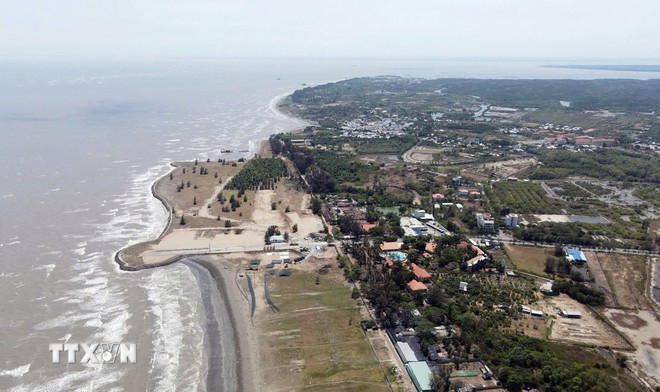
According to Doanh, Can Gio possesses distinctive advantages with unique mangrove ecology, rich biodiversity, strategic coastal location of Ho Chi Minh City and a large land reserve. These factors give Can Gio the potential to become an exemplary ESG++ coastal megacity of Asia in the next decade.
Vietnam Real Estate Association Vice Chairman Pham Nguyen Toan noted that for coastal reclamation aimed at urbanisation to succeed, it must meet three requirements: proper technology for durable foundations, proper planning for environmental regeneration, and proper vision for transformational national value.
He emphasised that advancing to the sea not only creates land but unlocks new growth space, new business hubs and new value chains in tourism, services and technology areas where inland development is increasingly constrained.
Experts cited the geological characteristics of Can Gio, where soft mud requires advanced foundational solutions. The Japanese K-DPM in-situ solidification technology was presented as the optimal method to reinforce ground load capacity, reduce subsidence, lower environmental impact and optimise lifecycle costs.
The technology has been applied in Tokyo Bay and in disaster-prevention works in Japan. In Can Gio, AOMI Japan and MCIC Vietnam are collaborating to transfer, standardise and localise K-DPM.
AOMI representative Okori Katsumi explained that Japan began land reclamation centuries ago, first using cement-soil mixing but later shifting to K-DPM due to its ability to handle large volumes, deliver material over long distances and reduce ecological impact.
MCIC Vietnam Chairman Tran Thanh Trung confirmed that K-DPM mixes mud and additives using compressed air inside pipelines, producing light, solid, homogeneous and waterproof material. The solution shortens construction time, reduces load and subsidence, and enables long-term operational safety under tidal and sea-level rise conditions.
He said the choice of K-DPM reflects Vingroup’s ESG++ orientation for Vinhomes Green Paradise, prioritising sustainability despite higher upfront costs.
Can Gio is undergoing large-scale regional infrastructure development such as the Ben Thanh–Can Gio high-speed rail (13-minute travel time), Can Gio Bridge (from 2026), the Can Gio–Vung Tau sea-crossing route (from 2029) and international port–logistics linkages.
Experts likened such infrastructure to runways enabling the city to take off. With high-speed rail integrated with transit-oriented development (TOD), Can Gio would transform from a peripheral area into an international destination, comparable with leading coastal cities in the region.
Under this scenario, travel time from Ho Chi Minh City to Can Gio will be reduced to around 13 minutes, reshaping perceptions, boosting economic flows and elevating the area into a natural extension of the city’s urban core, with strong impacts on economy, population and real-estate value./.