
Hanoi’s street food continues to win the hearts of international visitors, not only for its distinctive flavours but also for the unique dining spaces and lifestyle it reflects.
Most recently, the capital ranked second among the “Top 10 Asian destinations with the best street food” in a list released by the UK’s renowned Time Out magazine, reaffirming its growing appeal on the global culinary map.
For many foreign diners, the charm of Hanoi’s street food lies in the seamless blend of tradition and modernity, where food is inseparable from the rhythm of daily life.
Rida Belhamri from Morocco, owner of the TikTok channel “Rida in Vietnam”, has lived and worked in Vietnam for nearly three years. Sharing his impressions, he said that on the small streets of Hoan Kiem ward, familiar dishes such as banh mi, bun cha, pho, fried spring rolls and boiled snails do more than satisfy the palate.
They reflect the local way of life and the character of Hanoians – simple, unpretentious yet creative. Hanoi’s street food is very simple but refined, using a lot of fresh herbs with pleasant flavours, said Rida, emphasising that the dishes are always fresh, less greasy than street food in many other countries, and quite healthy. The broth is also excellent. This is why he is particularly fond of street food in the Old Quarter.
Jonty Joseph Jaxx from the UK said Hanoi’s street food bears a strong Vietnamese identity, unlike anywhere else he has visited.
“Each dish has its own uniqueness, with a wide range of flavours from savoury to sweet. Some dishes may resemble food from other countries, but they are adapted in a very Vietnamese way, such as Vietnamese-style beef steak or dried beef papaya salad,” he said.
When choosing where to eat, Jonty often looks for crowded and clean stalls or relies on recommendations from friends. Reasonable prices are also a deciding factor.
Sharing a similar approach, Sarah Garcia from Sri Lanka said she usually observes whether a stall attracts many customers and whether the food looks fresh before deciding to try it.
For Rida, sitting at simple, close-to-life street eateries is the most authentic way for visitors to understand and immerse themselves in the Vietnamese culture. He believes that a trip to Hanoi is incomplete without trying iconic spots such as bun cha on Hang Quat street, pho on Hang Trong street, banh mi on Hang Be street, or banh cuon in the Old Quarter.
American tourist Paul Griffin also highlighted the role of pavements and pedestrian streets in creating the unique vibrancy of the Old Quarter. “Eating on the pavement makes the area much more lively and attractive. That’s why many foreigners love coming back here – they can experience both culture and cuisine at the same time,” he said.
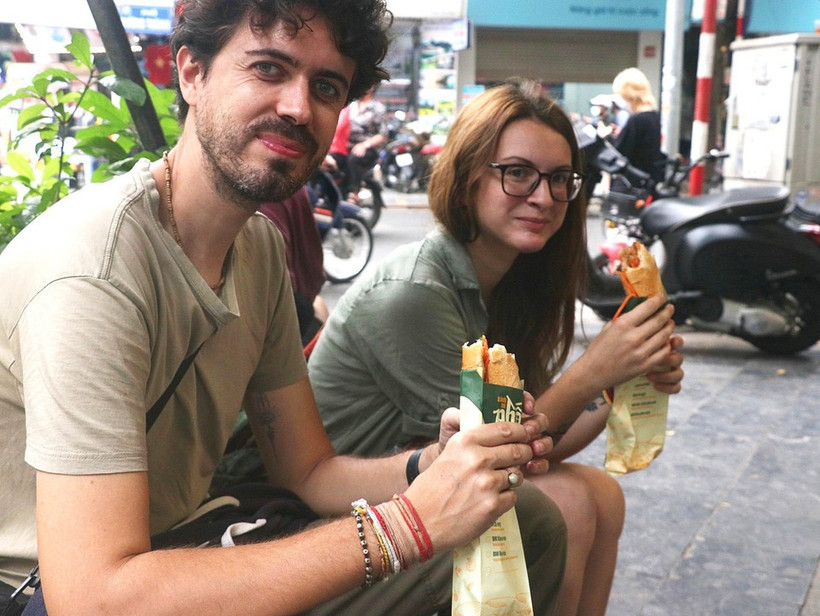
Among his favourites, Rida singled out banh mi with egg on Hang Bac street as the dish that left the deepest impression. He described it as a simple yet distinctive example of Franco-Vietnamese culinary fusion, recommending it to anyone visiting Hanoi.
While Hanoi’s street food is widely praised for its diversity, subtle flavours and distinctive dining spaces closely tied to everyday life, the city is also facing the challenge of balancing this cultural asset with the need to ensure urban order, traffic safety and a modern city image. As authorities step up efforts to restore urban discipline and manage the use of pavements, spontaneous sidewalk eateries are being gradually reorganised and regulated.
Experts and visitors alike agree that the solution should not be a mechanical removal of street vendors, but a well-planned and harmonious approach. Developing designated street food zones and conditional business areas could help preserve Hanoi’s culinary identity while ensuring urban aesthetics, public order and sustainable livelihoods./.