The sector recorded a trade surplus of 1.88 billion USD in November — 4.7% lower than in October but 43.3% higher than the same period last year.
Processing catfish for export at the Southern Fisheries Industries Company Ltd. plant in Can Tho city. (Photo: VNA)
Vietnam’s agro-forestry-fishery sector has set a new benchmark, posting an estimated 64.01 billion USD in export earnings in the first 11 months of 2025, a 12.6% rise year-on-year and already higher than 2024’s figure of 62.4 billion USD, the Ministry of Agriculture and Environment (MAE) reported.
Agricultural products remained the biggest contributor with 34.24 billion USD, up 15%. Livestock exports grew 16.8% to 567.4 million USD, aquatic products advanced 13.2% to 10.38 billion USD, and forestry exports climbed 5.9% to 16.61 billion USD.
Export turnover in November alone is estimated at 5.8 billion USD, down 3.7% from October but up 8.4% from a year earlier. Imports, meanwhile, reached 3.92 billion USD, a decrease of 3.2% month-on-month and 2.9% year-on-year.
For the 11-month period, agro-forestry-fishery imports rose 10.1% to 44.45 billion USD.
The sector recorded a trade surplus of 1.88 billion USD in November — 4.7% lower than in October but 43.3% higher than the same period last year. The cumulative surplus for the first 11 months reached 19.55 billion USD, up 19%.
A number of key agricultural commodities powered the sector’s strong performance. Coffee, fruit and vegetables, cashew nuts, and pepper all saw sharp gains, supported by robust global demand and rising export prices.
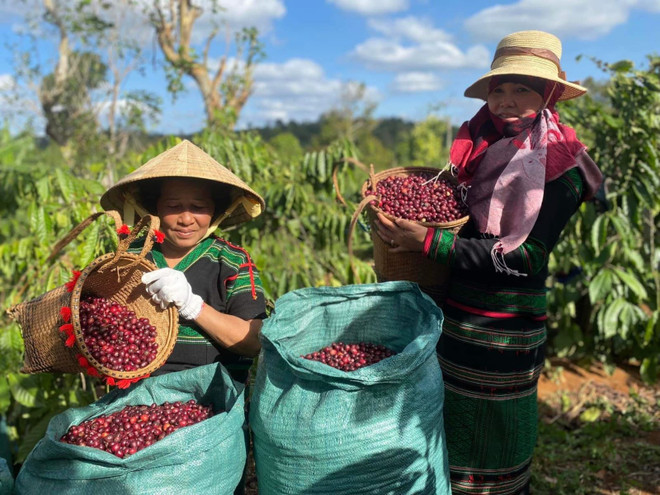 Vietnam holds distinctive advantages in agricultural development. (Photo: baotintuc.vn)
Coffee remained the standout, with overseas shipments reaching 1.4 million tonnes worth 7.88 billion USD during January–November, up 14.1% in volume and 59.7% in value from a year earlier. Average prices surged nearly 40% to 5,667.6 USD per tonne. Germany, Italy, and Spain were the biggest buyers, while Mexico recorded a spectacular 26-fold increase.
Fruit and vegetable exports also performed strongly, climbing 19.5% to 7.91 billion USD on sustained demand from China and growing shipments to the US. Cashew exports rose nearly 20% in value to 4.76 billion USD despite only small volume growth, reflecting higher prices.
Pepper saw the steepest price gains as the export volume fell, but value still rose more than 23% to 1.5 billion USD.
However, several major commodities posted declines. Rice experienced the sharpest fall, with both volume and value down amid intense global competition and falling prices. Shipments reached 7.5 million tonnes worth 3.83 billion USD, down 11.5% and 27.7%, respectively. Tea and rubber also continued to soften due to weak demand and market volatility.
According to the MAE, the sector will continue pushing both domestic consumption and export growth as it works toward the 2025 export goal of around 70 billion USD. In response to the US’ reciprocal tariffs, the ministry is rolling out a package of adaptive measures covering science and technology, markets, policy, economic diplomacy and industry linkages, alongside enhanced support for exporters in market access and trade promotion./.