Vietnam consistently pursues a foreign policy of independence and self-reliance, diversification and multilateralisation of international relations, Vietnamese Ambassador to Argentina Ngo Minh Nguyet said in a speech to professors, lecturers and students at the Catholic University of Argentina (UCA) in Buenos Aires on June 2.
Vietnamese Ambassador to Argentina Ngo Minh Nguyet (first, left) speaks about Vietnam's foreign policy at the Catholic University of Argentina (UCA). Photo: VNA
Vietnam consistently pursues a foreign policy of independence and self-reliance, diversification and multilateralisation of international relations, Vietnamese Ambassador to Argentina Ngo Minh Nguyet said in a speech to professors, lecturers and students at the Catholic University of Argentina (UCA) in Buenos Aires on June 2.
The event was held as part of the activities of the Association of Southeast Asian Nations (ASEAN) Committee in Argentina in 2026. It brought together the Ambassadors of Vietnam, the Philippines, Indonesia and Thailand, along with the Chargé d’Affaires of Malaysia’s Embassy in Buenos Aires, for an exchange with the university’s academic community and students.
In her remarks, the Vietnamese diplomat underscored that Vietnam continues to uphold its “strategic autonomy” model, cooperating with all powers, not joining military alliances, not taking sides in great power competition, and ensuring the capability to defend its national interests. She also reiterated Vietnam’s “Four No's” defence policy.
Vietnam is currently the only country maintaining comprehensive strategic partnerships with all five permanent members of the United Nations Security Council – the US, China, Russia, the United Kingdom and France, she said.
Responding to students’ questions about relations between major powers and ASEAN, Ambassador Nguyet expressed confidence in ASEAN’s central role in regional architecture. She stressed that the grouping’s relevance lies in its ability to manage strategic competition, sustain dialogue, prevent conflicts and foster strategic trust among countries.
For her part, Philippine Ambassador Grace T. Cruz-Fabella, Chair of the ASEAN Committee in Buenos Aires in 2026, provided an overview of ASEAN, describing it as one of the world’s most dynamic economic regions with a combined GDP exceeding 4 trillion USD. She noted that the bloc’s economy is supported by three key pillars – industry, services and agriculture. The diplomat also highlighted the successful holding of the 48th ASEAN Summit in Cebu, the Philippines, in May.
The ambassadors of Indonesia and Thailand, together with the Malaysian Chargé d’Affaires, answered a range of questions from UCA students concerning cooperation with Argentina and prospects for expanding trade and economic exchanges.
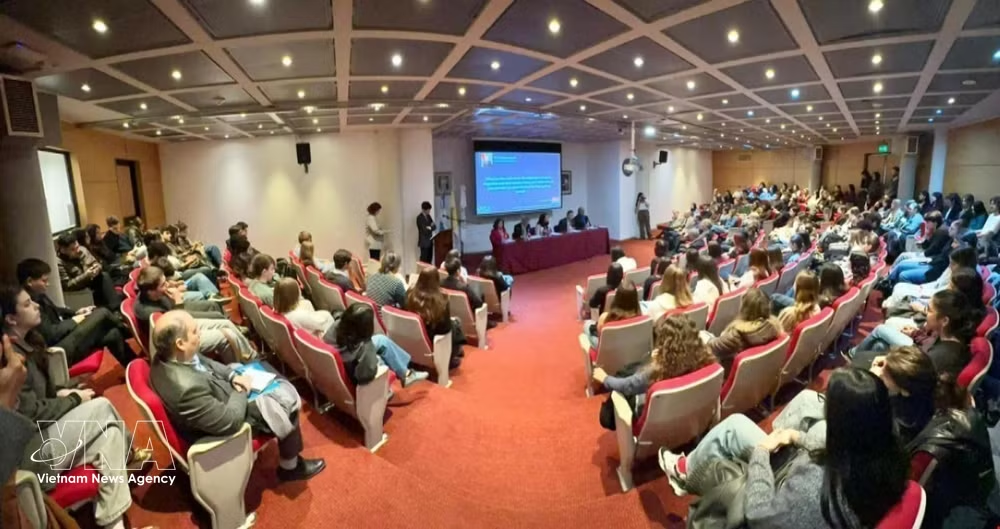 A large number of professors, lecturers and students of the Catholic University of Argentina participate in the exchange. Photo: VNA
On the occasion, UCA Rector Miguel Ángel Schiavone said the ASEAN Committee’s visit to Buenos Aires offered an opportunity to strengthen mutual understanding between Argentina and Southeast Asia, encourage dialogue between diplomats and students, and explore future academic cooperation.
Meanwhile, Verónica Muñoz, Director of International Relations and Academic Cooperation, affirmed that internationalisation is a strategic priority for the university. The UCA is expanding student and faculty exchanges, broadening international partnerships, internationalising curricula, promoting collaborative learning initiatives and participating in global projects. The university is also seeking stronger engagement with Asia and ASEAN.
Founded in 1958, the UCA is one of the leading private universities in Argentina and Latin America, offering undergraduate, postgraduate and doctoral programmes in social sciences, humanities, law, economics, engineering, medicine and theology./.