In 2014, Vietnam was elected to the United Nations Human Rights Council with the most number of votes (184/192 votes). This shows the international community’s recognition of the efforts and achievements of Vietnam in ensuring people’s rights in all areas, including religion. The daily life in Bui Chu, Ea Tul, Tra Vinh and other parts of Vietnam are true evidence of this recognition.
New life in Bui Chu
Bui Chu diocese in Xuan Truong District, Nam Dinh Province has existed for a long time and has been associated with many important events relating to the establishment and development of Catholicism in Vietnam.
Bui Chu Cathedral in Xuan Ngoc Commune was inaugurated in 1885. It is an old, large church of Western architecture where masses with about 1,800 parishioners in the region are held.
Nun Nguyen Thi Lan took us to visit the church. She said that at present the church has more than 100 nuns. After praying, all the nuns do different work, including growing rice and medicinal plants to produce medicine for curing the people in the area, making money and nurturing the orphans and disabled children at the Thanh An Orphanage.
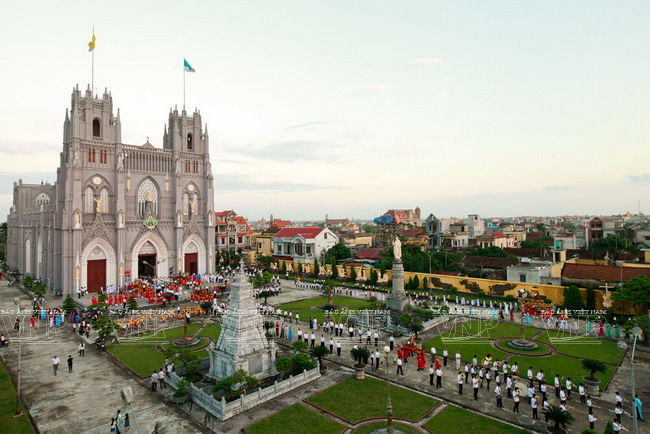
Parishioners in Bui Chu diocese attend a procession ceremony at Phu Nhai Church
(Xuan Phuong Commune, Xuan Truong District, Nam Dinh Province). Photo: Viet Cuong/VNP
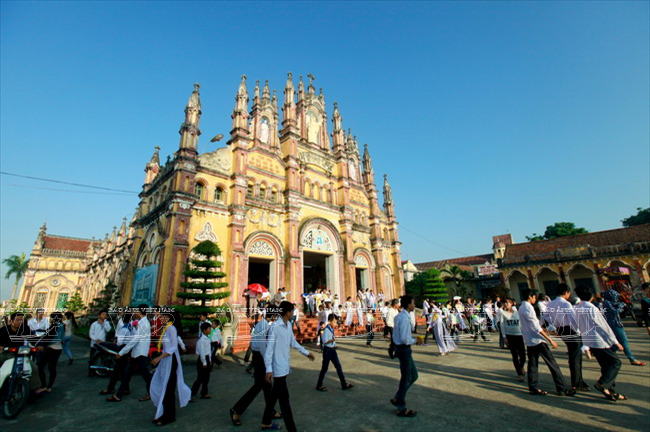
Bui Chu parishioners go to Trung Linh Church to attend mass on Sunday. Photo: Viet Cuong/VNP
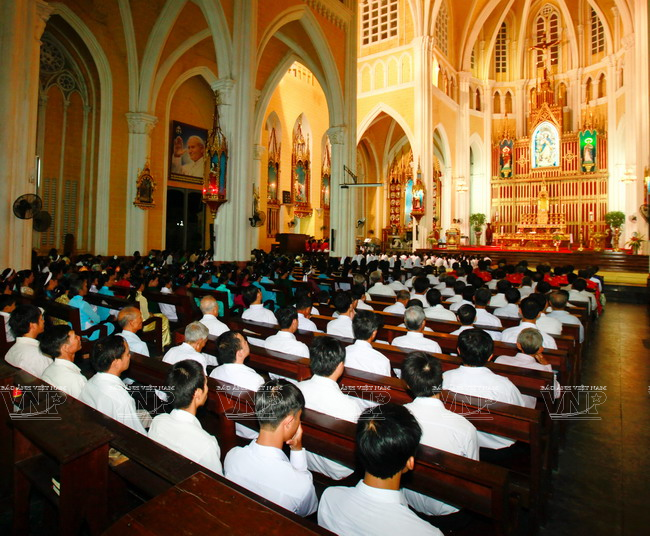
A mass on Sunday at Phu Nhai Church in Bui Chu Diocese, Nam Dinh. Photo: Viet Cuong/VNP

Catholic Priest Nguyen Duc Giang holds a wedding ceremony
for a young couple at Bui Chu Cathedral. Photo: Viet Cuong/VNP
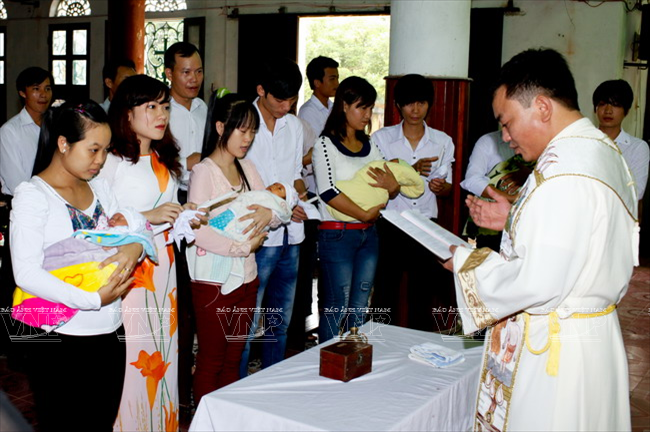
A christening ceremony at Trung Linh Church, Bui Chu Diocese. Photo: Viet Cuong/VNP |
«
Bui Chu diocese has the smallest area among the 26 dioceses of the Catholic Church in Vietnam (about 1,350km2). It is situated only in 6 districts of Nam Dinh Province, but it has over 400,000 parishioners, a fairly high number, accounting for 34% of the population. Of them 84% are engaged in farming and 11% are engaged in trade and services, such as engineering, fine arts and handicrafts.
»
|
We were fortunate to attend a wedding at Bui Chu Cathedral. With the Western music and the light of the candles inside the church, the young couple gave each other wedding rings representing fidelity, in the presence of Father Nguyen Duc Giang. We shared their happiness. That day, Bui Chu diocese had a happy ceremony.
Like many other rural areas, Bui Chu diocese was once a poor rural area and the parishioners mainly lived by farming. In recent years, thanks to the care and assistance of the authorities at different levels, the parishioners have borrowed money to expand production and change occupations, so the number of companies and plants owned by the parishioners is increasing.
Tran Van Truong, a parishioner in hamlet 6 of Xuan Tien Commune, Xuan Truong District said that after graduating from the Mechanical Engineering Faculty of the University of Transport, he opened his workshop to produce saw blades of different types. Now his workshop has over 20 workers, each earning an average monthly income of about 6 million dong each. To expand production, Truong has bought 20 modern CNC cutting machines, each of which costs about 200 million dong.
Saying goodbye to Truong we went to Xuan Phuong Commune of Xuan Truong District to attend a procession ceremony at Phu Nhai basilica. This is a great celebration of the Catholics to show respect for their predecessors and commemorate their ancestors.
Pham Cong Chinh, head of the executive committee of Phu Nhai parish said that on this day, those Catholics who work away from home return to participate in the celebration. This year it was estimated that thousands of people attended the event. All the people were happy and excited because the ceremony was larger than the previous year and they saw the changes in their native land.
Religious life in Ea Tul
On a November morning in Tay Nguyen (the Central Highlands), the weather was extraordinarily cool. When the first rays of dawn appeared behind Cu M’gar Mountain, people throughout Ea Tul Commune, Cu M’gar District, Dak Lak Province flocked to the Protestant church to attend a mass. For more than 3,000 Ede ethnic people who are Protestants, the mass on the first Sunday of November is the most important.
At 8:30, the mass began with hymn singing performed by Ede girls in their traditional costumes at the chancel. While the song was being sung, Pastor Y Ky Eban spoke to us in a low voice: “The singers should have dressed in accordance with the religious laws, but here they wore Ede ethnic attire to promote the ethnic culture and to show that the believers of God, regardless of their races, sing the hymns with respect and devotion to the work entrusted by God”.
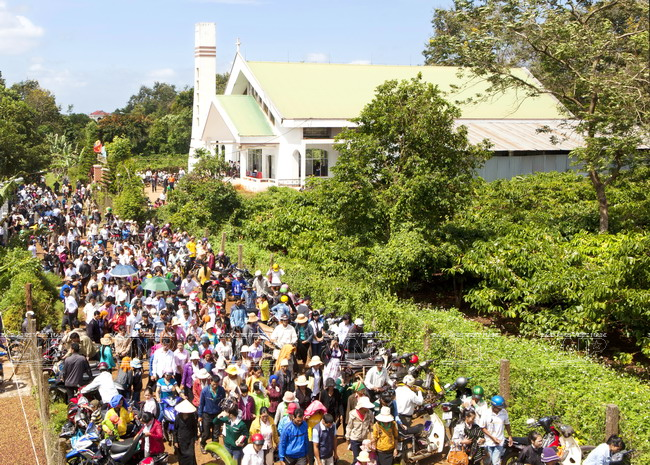
Over 3,000 Protestants in Ea Tul Commune attend church on the first Sunday of November. Photo: Tat Son/VNP
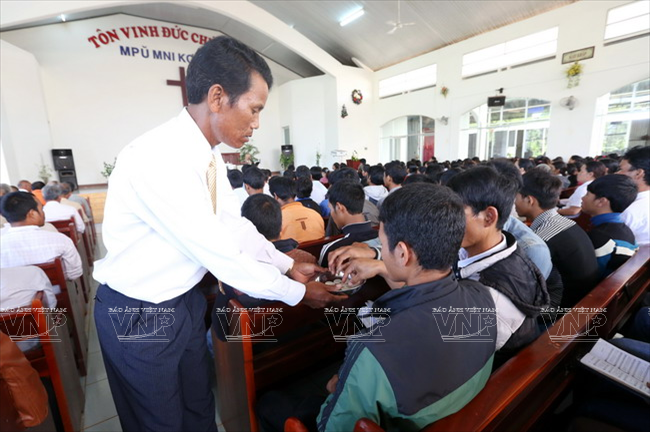
The rite of presenting holy bread to Protestants. Photo: Tat Son/VNP
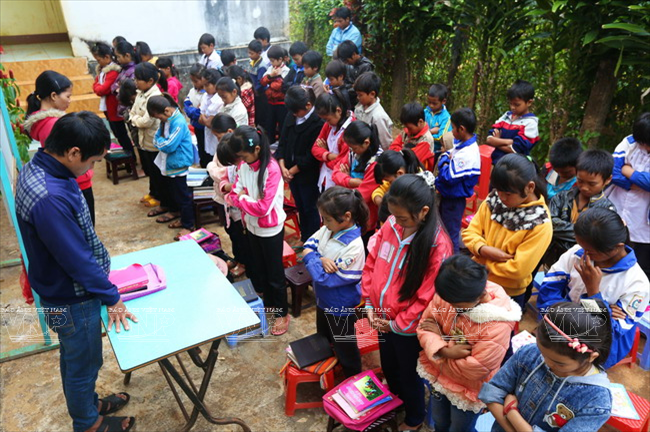
Bible class for 7-9 year-old children at Ea Tul Church. Photo: Tat Son/VNP
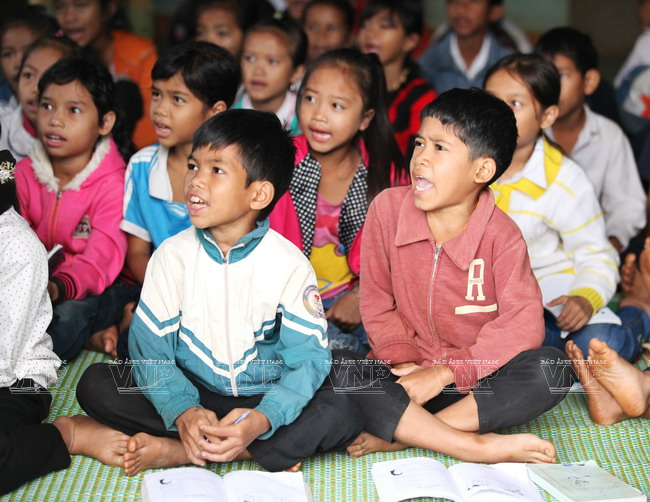
Hymn class for children in Ea Tul held by the Youth Union of Ea Tul Commune
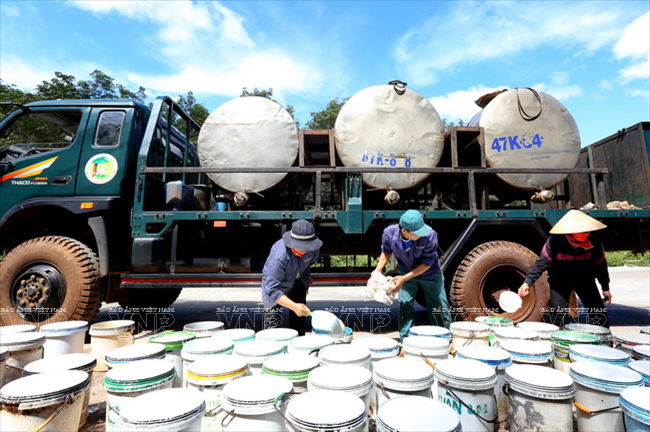
Protestants in Ea Tul develop their economy from growing rubber trees. Photo: Tat Son/VNP
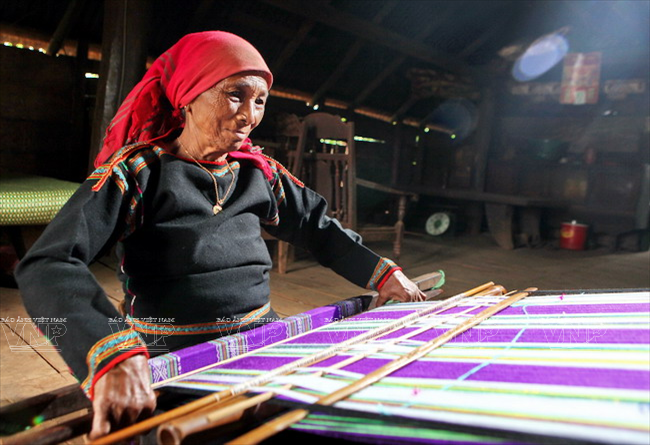
Elder H Hwing, 81 years old, said that the local authorities support the Ede people
in recovering and preserving the traditional craft of weaving. Photo: Tat Son/VNP
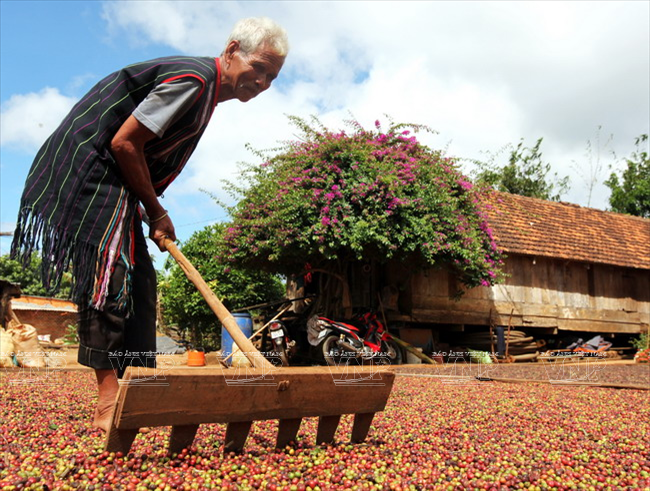
Y Ho Nie dries coffee in his yard. Photo: Tat Son/VNP
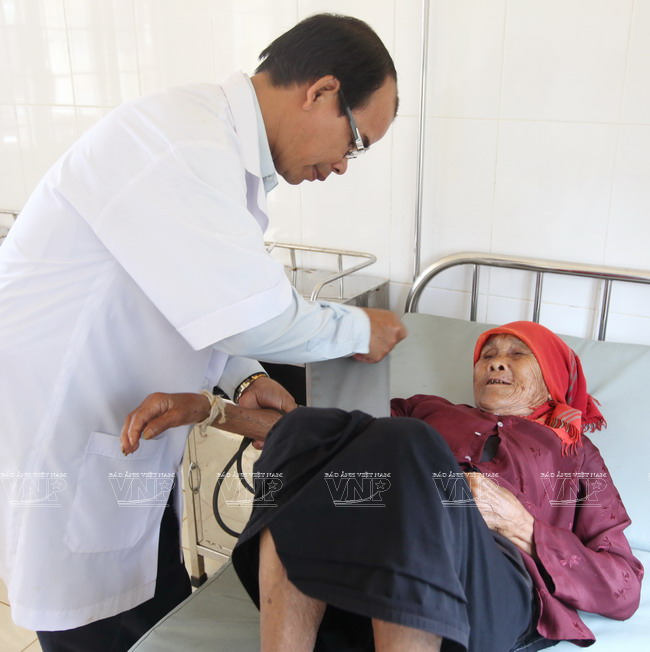
Giving medical treatment to the locals at the Medical Station in Ea Tul Commune. Photo: Tat Son/VNP |
Pastor Y Ky Eban who has managed the Protestant Association in Ea Tul for nearly 10 years is called “Mr. Advisor” of the hamlets by the believers. All of the families having problems and disagreements with their neighbours come to the pastor to consult. Even when the villagers do not understand the policies of the State they consult the pastor for thorough explanations. It may be the reason why when he chairs and teaches the tenets, using the Ede language, over 3,000 believers listen to him respectfully.
The mass ended but many believers in Ea Tul stayed in the church to listen to Pastor Y Ky Eban’s talk about the situation in the village. He admonished the believers not to dry coffee beans on the village road and lanes to avoid traffic impediment. Seeing that the believers worried about the fluctuation of coffee prices he explained that it was the beginning of the season so the price was not stable. According to the Vietnam Economic Times coffee prices tended to increase, so the villagers should not worry.
At the church we also met Y Nun KTLa, a pleasant Ede Protestant. He enthusiastically invited us to his house to enjoy coffee of the early season. At his house there was a hymn class for about 40 children ages 5-7, organized by the youth union of Ea Tul Commune Protestant Association.
When Y Nun KTLa asked the children: “What should we do to serve God?” they replied in unison: “Serving God is to listen to the advice of the teachers and parents and not to do bad things as said in the Bible”. Thus, Protestantism in Ea Tul has come into the life of the Ede people from such simple things!
Going to Buddhist land in the southwest
Unlike people in Bui Chu (Nam Dinh) or in Ea Tul (Dak Lak), most of the Khmer ethnic people in the southwest follow Theravada. We went to Tra Vinh in the last days of May. Although the sun was blazing, the Khmer people from all parts flocked to Hang Pagoda to attend the Kathina offering ceremony which is the biggest festival of the Theravada followers. It is the day the Buddhist followers show their devotion to assisting the sangha and honouring the traditional values of Buddhism.
Like many other Buddhists, Pha La went to Hang Pagoda to attend the ceremony. His house is in Phuong Thanh Commune of Cang Long District, about 30 kilometers from Hang Pagoda, so Pha La and his family had to get up early in the morning to go to the pagoda. He said he was taken to the Kathina ceremony when he was a little boy. On this day, the Buddhist followers go to the pagoda to listen to the monks’ teachings on Dhamma, parents’ nourishment and human behaviour. Pha La’s heart has been imbued with these teachings.
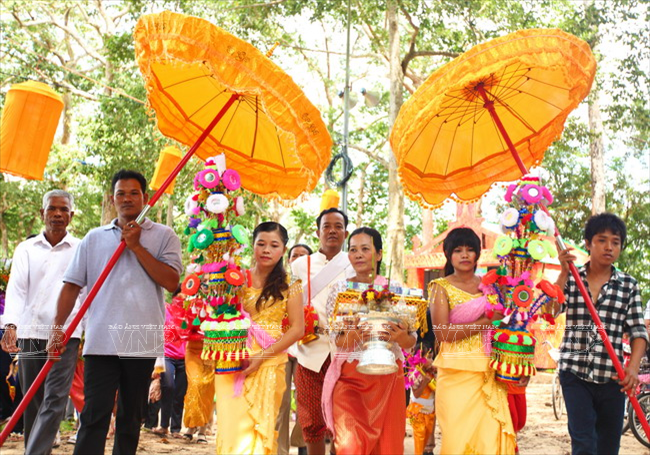
Most of the Khmer ethnic people in Tra Vinh Province follow Theravada. Photo: Nguyen Luan/VNP
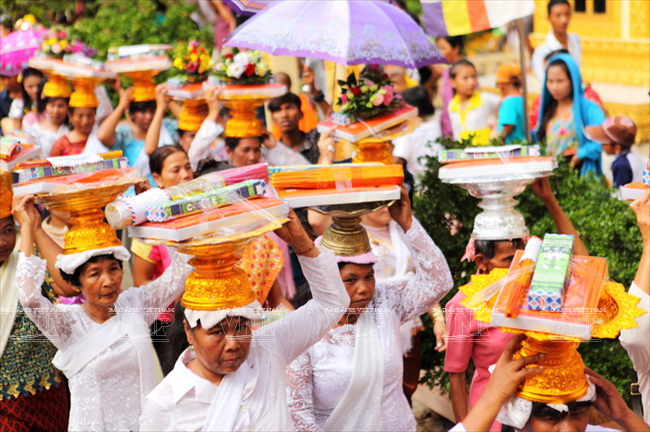
The Khmer people bring offerings to the Buddha. Photo: Nguyen Luan/VNP

Khmer children attend the Kathina Ceremony in Tra Vinh. Photo: Nguyen Luan/VNP

A class to teach Khmer language for monks in Tra Vinh. Photo: Nguyen Luan/VNP
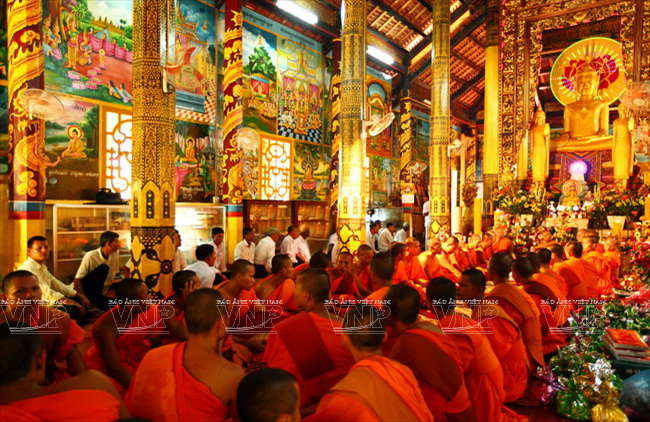
Monks hold the Kathina Ceremony. Photo: Nguyen Luan/VNP
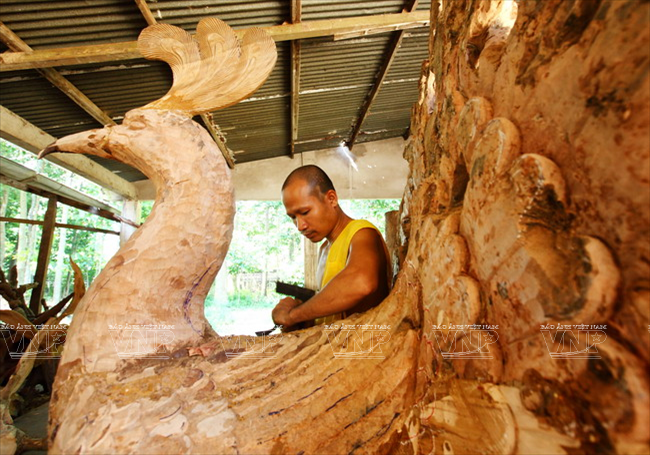
A monk learns the wood carving traditional craft at Hang Pagoda. Photo: Nguyen Luan/VNP |
There are about 1.3 million Khmer people living in the Mekong Delta region, mainly in Tra Vinh, Soc Trang and Kien Giang Provinces. As of May, 2014 the Khmer Theravada has 454 pagodas and over 8,500 monks. Tra Vinh Province has the greatest number of pagodas with 142 pagodas and 3,100 monks.
We went to Chau Thanh Town where there is the famous Hang Pagoda built in 1637. Monk Thach Suong, the 23rd verger of the pagoda has led a religious life for many years and has a wide knowledge of Buddhist scriptures. He is virtuous and is greatly respected by the local people.
To create a stable job for young people in the area as well as to preserve the traditional craft of the forefathers, monk Thach Suong has established a wood-carving workshop at the pagoda to teach the craft for them. So far, 60 young Khmer people have been trained to become artisans. Good news has spread and not only the people in the area but many people in other provinces such as Soc Trang, Vinh Long and Can Tho have come to learn the craft.
In addition to the wood-carving class, Hang Pagoda has also opened a class to teach the Khmer language to help the Khmer people preserve their scripts and read prayer books written in the Khmer language.
Over the past years, thanks to the policies and great investment of the State, the religious life as well as the economic, cultural and social life of the Khmer Buddhists in Tra Vinh has changed a lot. So, the cheerful atmosphere prevails everywhere.
A recent research on religious diversity conducted by the Pew Research Center (USA) has ranked Vietnam as the third largest country in the world in terms of religious diversity, only behind Singapore and Taiwan.
The research reflects the objective reality of the religious painting of Vietnam today. So far, the Vietnamese State has officially recognized dozens of religious organisations like Catholicism, Protestantism, Buddhism, Islam, Hinduism, Bahaism and other extrinsic religions (Caodaism, Minh Su, Minh Ly, Buu Son Ky Huong and Tu An Hieu Nghia). Besides, there are also many religious groups operating in families or locations which have been registered with the authorities |
Story: Quynh Anh, Thong Thien & Nguyen Oanh - Photos: Viet Cuong, Tat Son & Nguyen Luan