Prime Minister Pham Minh Chinh stressed that international integration is a major issue of strategic significance, not only in Vietnam’s foreign policy but also in the overall national development strategy.
Prime Minister Pham Minh Chinh speaks at the conference on January 14 to review the National Steering Committee for International Integration’s performance in 2025 and outline key tasks for this year. Photo: VNA
Prime Minister Pham Minh Chinh, who heads the National Steering Committee for International Integration, chaired a conference on January 14 to review the committee’s performance in 2025 and outline key tasks for this year.
The event was held in person at the Government headquarters and connected online to all 34 cities and provinces.
In his opening remarks, PM Chinh noted that the Politburo has recently issued nine major, strategic resolutions serving as pillars for national development across various sectors, including Resolution No. 59-NQ/TW on international integration in the new context. These have been followed by resolutions and laws adopted by the National Assembly, as well as action programmes issued by the Government to ensure implementation.
He stressed that international integration is a major issue of strategic significance, not only in Vietnam’s foreign policy but also in the overall national development strategy. It plays an important role in promoting socio-economic development, strengthening national defence and security, expanding external relations, enhancing national stature, and safeguarding the interests of the country and the nation.
Recalling that Vietnam’s renewal process was built on three pillars of abolishing bureaucracy and subsidies, developing a multi-sector economy, and promoting international integration, the Prime Minister emphasised that profound changes in the current global and domestic context require corresponding changes in mindset, approach, and methods. Resolution No. 59-NQ/TW, he said, defines new thinking and approaches to international integration in order to seize emerging opportunities while mitigating risks arising from global volatility.
The consistent viewpoint of international integration is that it is the cause of the entire political system and the whole people, under the leadership of the Party and the management of the State, during which people and enterprises are placed at the centre, serving as both driving forces and key resources. The overarching objective is to improve the quality, effectiveness, coherence, and depth of international integration, maintain a peaceful and stable environment, mobilise external resources to build an independent and self-reliant economy, preserve and promote cultural values and human potential, and enhance the country’s comprehensive strength, role, and international standing.
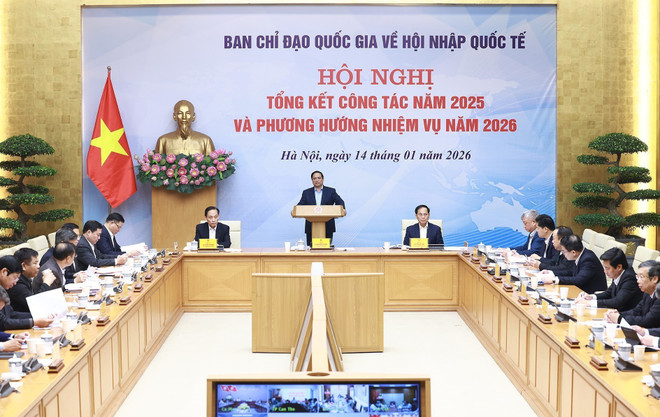 Prime Minister Pham Minh Chinh speaks at the conference on January 14. Photo: VNA
Despite global declines in economic growth, investment, and trade over the past year, the Government leader noted that Vietnam recorded increases in import-export turnover and achieved a record-high FDI disbursement of approximately 28–29 billion USD, reflecting growing confidence among foreign investors and providing strong impetus for domestic investment.
He emphasised that international integration must be pursued in a more concerted, comprehensive, and effective manner, shifting from a mindset of “receiving, joining and participating” to one of proactive contribution, engagement, and helping shape international relations.
Vietnam is willing to play a core and constructive role in mediation on global peace, security, and development issues, PM Chinh affirmed.
At the conference, he requested the steering committee’s members to thoroughly review and assess the implementation of international integration work over the past year, particularly the implementation of Resolution No. 59-NQ/TW, and identify key priorities for the coming period.
Discussions should clearly identify achievements and shortcomings, analyse underlying causes, draw lessons learned, assess and forecast global developments, and propose appropriate and effective solutions as Vietnam enters a new era of development, he added./.