|
|

“Imprints of the Past” highlights the
aristocratic and graceful beauty.
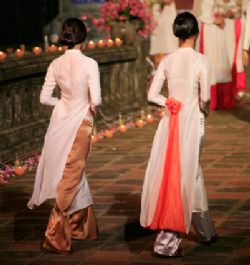
The
exquisiteness ofHue’s Ao dai.
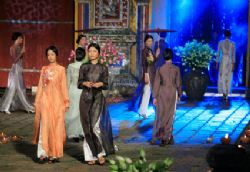
Hue women’s
gracefulness can be clearly
seen via their long dress.
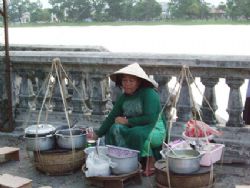
Women vendors also wear Ao
dai.

The beauty of Ao
dai is enhanced in a space full of
Hue
identities.
| Many people say that residents of Hue (the old imperial city of Vietnam
during 1802-1945), from the members of reputed families to ordinary
traders and retailers, are always decent in their speaking and gestures.
Wearing an old Ao dai (traditional long dress) torn out
with time, or made with luxurious velvet or silk, Hue women always retain
their gracefulness and gentleness.
According to Phan Thuan An, a researcher of
Hue's culture, variations of the Ao
dai from Hue have been closely linked to
historical ups and downs. Under the Minh Mang Dynasty (1820-1841), to
solve the differences of clothes worn by people from different regions
after the conflict of the Trinhs and the Nguyens (1623-1777), King Minh
Mang issued a royal ordinance about the uniform nationwide, under which
royal concubines and maids had to wear the Ao dai when they left
the royal palace. Ordinary people had to wear trousers and they were
prohibited to wear skirts. To adults, Ao dai was a "must" outfit.
In the early 20th century, especially
since 1917 when the Dong Khanh High School for female students was established,
female students were ordered to wear Ao dai as their school
uniform. At present, students of Hai Ba
Trung High School (old Dong Khanh School) and many other schools in Hue are encouraged
to wear the white Ao dai and trousers as their school
uniform.
Over the past years, although materials and designs
of the Ao dai have been changed, women from Hue are loyal to
their traditional Ao dai . Their thinking of the garment
colours and usage remains unchanged. Besides students who wear the
Ao dai at school, Hue women wear the Ao dai when
they go to pagoda or during festive days which make them look both elegant
and ceremonial. State female employees also like to wear the Ao dai at their
offices.
Hue
women choose the colour for their Ao dai to be in line with the
colour of the sky and surrounding environment and the unique solemn look
of the imperial city of Hue. A local saying goes, "look at the
colour of the sky in order to choose the colour of the dress". The dress
worn at festive days often have bright colours; at worship and ritual
ceremonies they are brown, purple, blue and milky, and with hidden
designs. On rainy days the dress is often dark, and on sunny days it is
light and bright. Hue women like to wear the purple Ao
dai, which is not too light
or too dark.
The traditional Ao dai of Hue is so beautiful
and romantic that it has become a topic for fashion designers to explore
its beauty. Some are successful, while many fail, for the Ao dai of
Hue is not
something easy to renew or change. Famous designer Minh Hanh, who has many
years in designing and collecting the Ao dai, said: "If someone
designs a Hue Ao dai that does not
reflect a Hue style, that dress is not one
of Hue ."
At Festival Hue 2008, Minh Hanh and other young fashion designers
presented to the public a collection entitled "Imprints of the Past". The
dress is designed in the old traditional style with classical designs and
imprinted with a Hue style, which fully
reflects the elegance and grace of Hue women.
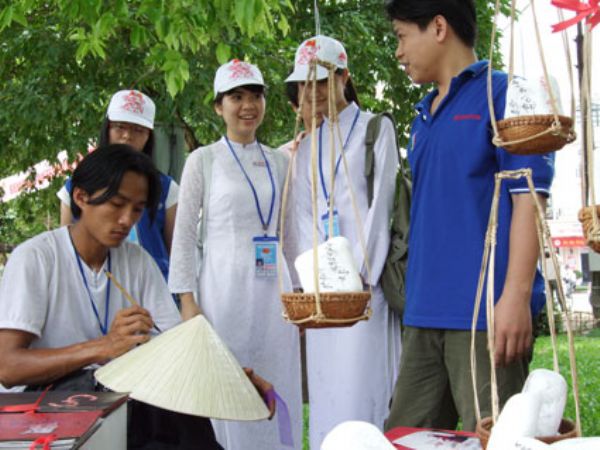
Hue students wear
Ao dai as their uniform.
Story by Thanh
Hoa - Photos by Dinh Cong
Hoan |