The city is now shifting its development strategy to focus on the community, empowering local residents to become true guardians of heritage by preserving, creating, and directly enjoying the benefits of their cultural legacy.
Dien Tho Palace (within the Complex of Hue Monuments) serves as the residence of the Empress Dowagers and Grand Empress Dowagers during this period. It is one of the distinctive architectural structures that has remained almost intact to the present day. Photo: VNA
Hue, often called a “living museum” of Vietnamese culture, is facing the challenge of having plenty of tourism products but not enough charm to draw visitors.
The city is now shifting its development strategy to focus on the community, empowering local residents to become true guardians of heritage by preserving, creating, and directly enjoying the benefits of their cultural legacy.
Diverse products, but lacking pull
From the imperial citadel complex, royal tombs and pagodas to traditional craft villages, court and folk cuisine, a tranquil lifestyle and vibrant festivals, Hue possesses a remarkably rich tourism landscape rarely matched elsewhere.
Various tourism types have emerged, from heritage tourism, community-based tourism, craft village experiences, wellness, and spiritual tourism, to culinary tours and nighttime activities. However, many remain small-scale, fragmented, and lacking depth of experience, failing to form a sufficiently strong ecosystem to retain visitors for longer stays.
After the success of the film "Mat Biec" (Dreamy Eyes by Victor Vu), several cinema-themed spots in Hue saw a surge of young visitors. But as the movie’s buzz wore off, many of these spontaneous tourism ventures slowed, highlighting both the city’s rich potential to blend culture, creativity, and tourism and the importance of a long-term, sustainable plan.
Meanwhile, many local traditional crafts are struggling to find their place in modern life. Once a source of pride for the former imperial capital, craft villages now risk decline due to volatile markets. Many survive primarily thanks to the dedication of artisans rather than a sustainable tourism value chain.
In Sinh village, artisan Pham Cong Khai is among the few remaining practitioners preserving a more than 400-year-old folk painting tradition, painstakingly carving woodblocks and printing zodiac worship prints. Yet industrialisation threatens the craft’s survival without adequate spaces for exhibition, experience and sales.
Similarly, Tran Dai Nghia, a well-known maker of "to he" (traditional figurines) in Huong Thuy, said the craft now exists largely as an experiential activity for schoolchildren. With products priced between 15,000 - 35,000 VND (0.57–1.33 USD), the income isn’t enough to make a living without extra support from events, night markets, or workshops. He hopes the city will provide more opportunities for the craft to grow and thrive within the community.
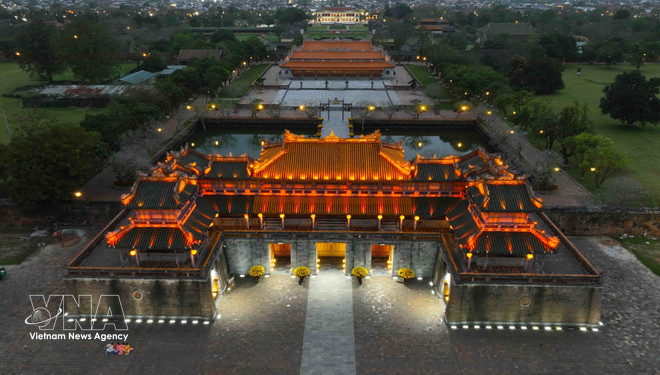 Ngo Mon — the principal southern entrance to the Imperial City of Hue. Photo: VNA
Heritage must “live” with community
According to Phan Thanh Hai, Director of the municipal Department of Culture and Sports, Hue possesses an exceptionally rich repository of tangible, intangible, and natural heritage. However, current exploitation remains largely “static” and has yet to activate the broader heritage ecosystem. For sustainable development, heritage must live within the community and reflect contemporary life, with residents playing the central role.
Experience shows that when local people are directly involved in tourism activities, heritage naturally “awakens”. The series of events marking the Lunar New Year of 2026 in wards and communes illustrated this clearly. The participation by artisans and creative young people created a bridge between generations, revitalising local cultural identity while drawing renewed attention to traditional craft villages.
In recent years, movements such as the revival of traditional "ao dai" attire and digital-media culinary start-ups have demonstrated the increasingly important role of Hue’s youth in injecting fresh energy into heritage promotion.
Along with community involvement, technology is seen as a major force for innovation. Cultural experts highlight that using digital tools and artificial intelligence for preserving, promoting, and interpreting heritage can greatly improve accessibility, especially for younger people and visitors from around the world. Virtual 3D tours of royal tombs, multilingual audio guides through smart apps, and interactive digital storytelling can turn heritage from static displays into lively, immersive experiences./.