In the winter crop 2011, the first beds of potatoes were covered with rotten straw which were actually a type of organic fertilizer made from rice straw composted with a bio-product, Biomix Fito RR. Nguyen Van Hung, a local farmer said that thanks to using the technique of composting the rice straw into fertilizer, the farmers in Tan Hung Commune no longer burned straw in the fields. They use organic fertilizer which is much cheaper than chemical fertilizers and causes no degradation to the land or pollution to the environment.
According to Nguyen Van Chi, Director of the Hanoi Agricultural Extension Centre, each year, Hanoi has about 200,000ha under rice cultivation, which yields an output of over one million tonnes of dried straw. Now, the soil preparation is mainly done by agricultural machines. The number of cattle which are raised to serve as beasts of burden has decreased, leading to a drop in rice straw as feed for the cattle. The use of straw as a fuel for cooking has been replaced by gas and electric stoves. It is estimated that about 80% of the rice straw after harvests are considered redundant. They are burnt or released into the flows, causing pollution to the environment and harm to people’s health. Taking full use of this redundant straws by processing them into fertilizer for the cultivation of edible mushrooms like in Tan Hung Commune is a necessary work. It not only contributes to protecting the environment but also increases the income of the farmers.
In late 2011, the Hanoi Agricultural Extension Centre collaborated with the Biotechnology Joint-Stock Company to build a model titled “Experimental treatment of straw after harvests to produce fertilizer with biological products”. This model was applied in eight districts which had rice fields on the outskirts of Hanoi. The centre also cooperated with the Biotechnology Centre under the Agricultural Genetics Institute to build a model titled “Experimental production of mushrooms on straw during the off-seasons” in four communes, including Tan Hung (Soc Son District), Doc Tin (My Duc District), Dong Xuan (Quoc Oai) and Hong Thai (Phu Xuyen).
According to Nguyen Van Chi, the technique of processing rice straw after harvest into organic fertilizer, using biological products is very simple, easy to do and can be implemented any place, such as in houses, gardens and fields. This fertilizer helps increase the area of plant cultivation for the winter crop, especially potatoes, stimulate the production of mushrooms during the off-seasons and create safe vegetable products. The farmers prepare the bio-products with a correct ratio, then mix them with the straws and compost the mixture for 10 days, keeping the temperature at 50-520C. When the mixture turns a brown colour and the mushroom bacteria develops, after 15 days the mixture is turned up. After 30-35 days the straw will rot and turn into organic fertilizer with a dark brown colour. On average, one tonne of dried straw yields 600-700kg of organic fertilizer. To produce mushrooms from the straws during the off-seasons, farmers can compost the straw after they finish the winter crop. The duration of time from fermenting the straw to harvesting the mushrooms is more than 20 days and the average output is 120kg of fresh mushrooms per one tonne of dried straw. Selling the mushrooms at the current price of 40,000 VND per kilo, farmers will earn a profit of nearly two million VND after deducting the production cost.
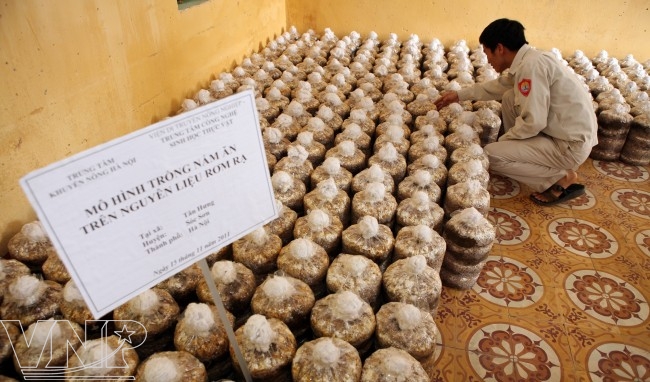
The average output is 120kg of fresh mushrooms per one tonne of dried straw. Selling the mushrooms at the current price of 40,000VND per kilo, farmers will earn a profit of two million VND after deducting the production cost.
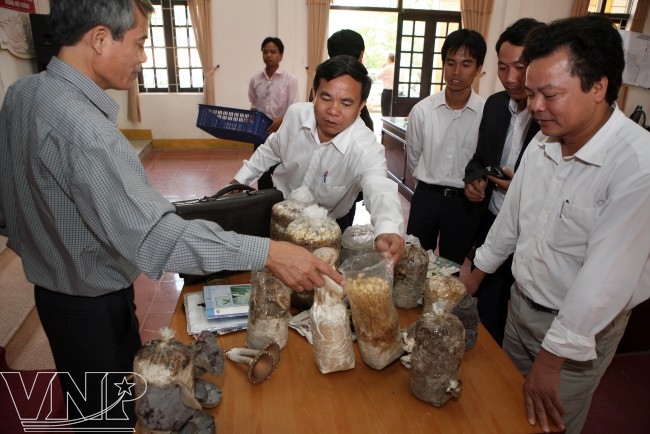
Using rice straw to grow mushrooms brings a high income to farmers.
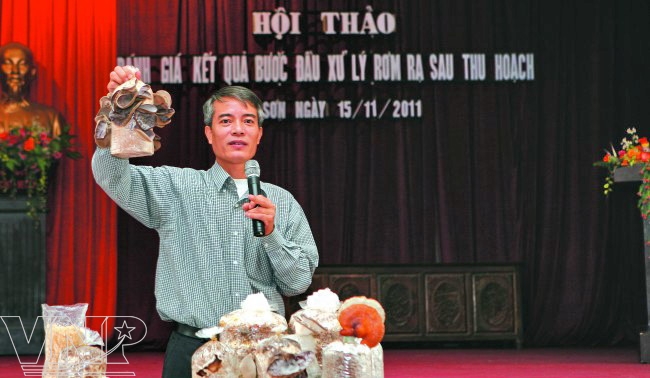
Introducing the technique of growing mushrooms at a workshop on evaluating the initial rice straw treatment after harvest. |
At a workshop to assess the initial success of the straw treatment model held recently, Dao Duy Tam, Vice Director of the Hanoi Department of Agriculture and Rural Development said that it is an environmental treatment model in agriculture. It has contributed to improving the farmers’ lives, so it should be extended to other districts throughout the country.