A range of fuel price support measures has been applied, including the use of the petrol price stabilisation fund and adjustments to taxes and fees. As a result, domestic fuel prices are currently lower than in most countries in the region, a significant effort under present conditions.
Prime Minister Pham Minh Chinh speaks at the meeting of the Government’s standing members in Hanoi on March 21. Photo: VNA
Under no circumstances should there be a shortage of energy in general and petrol in particular for production, business, and consumption, Prime Minister Pham Minh Chinh stressed while chairing a meeting of the Government’s standing members in Hanoi on March 21.
The meeting reviewed the Government’s response since late February to an energy crisis triggered by developments related to the conflict in the Middle East, as well as the implementation of the Politburo's Conclusion No. 14 dated March 20 regarding supply security and fuel price stabilisation in the new context.
Participants noted that timely, flexible and effective measures have been implemented and that the situation is now largely under control, with national energy security ensured.
The PM has held telephone talks, sent letters to leaders of several countries, and worked with major corporations and ambassadors of energy and fuel-related nations in Vietnam to coordinate responses to the crisis. Deputy PMs have directed ministries, sectors and enterprises to closely monitor developments and address emerging issues.
A range of fuel price support measures has been applied, including the use of the petrol price stabilisation fund and adjustments to taxes and fees. As a result, domestic fuel prices are currently lower than in most countries in the region, a significant effort under present conditions.
In his conclusion at the meeting, PM Chinh underscored the need for both immediate solutions and long-term structural measures.
He ordered that fuel supply management be considered within the broader context of socio-economic development, political stability, public order and safety, and improvements in people’s material and spiritual well-being, while supporting double-digit economic growth targets for 2026 and beyond and mitigating potential risks.
The government leader asked relevant ministries, sectors and enterprises to strictly and effectively implement the Politburo’s directions under its Conclusion No. 14.
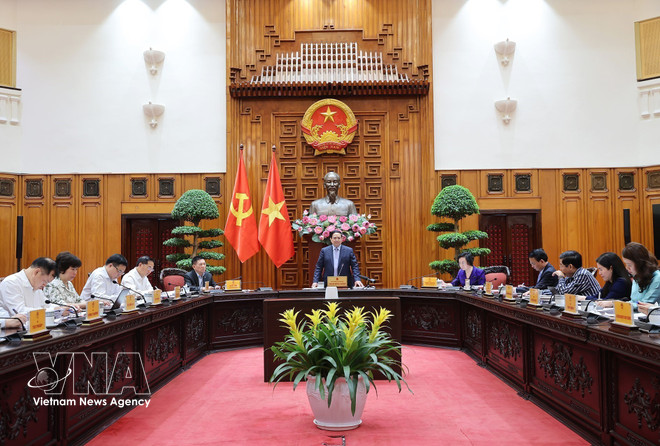 A view of the meeting of the Government’s standing members in Hanoi on March 21. (Photo: VNA)
Among key tasks given by the PM, the Ministry of Industry and Trade was asked to closely monitor and forecast global and domestic fuel market developments, assess supply-demand balances and prices, and develop appropriate response scenarios within its authority.
The ministry was also requested to coordinate with the Ministry of Finance and related bodies to accelerate the replenishment of national petroleum reserves and improve mechanisms for emergency release of reserves in accordance with the law on national reserves. In the longer term, the planning and construction of a strategic storage system are required.
The Ministry of Finance was tasked with deploying fiscal and price-management tools, strengthening supervision of the petrol price stabilisation fund, and developing a national strategy for the supply and stockpiling of essential raw materials and fuels in both the short and long term.
The Governor of the State Bank of Vietnam was instructed to direct credit institutions to facilitate access to loans, preferential interest rates and foreign currency for petrol enterprises to support imports, storage and distribution in accordance with regulations.
The PM also demanded the Ministries of Foreign Affairs; Industry and Trade; and Finance to intensify engagement with foreign partners to ensure stable supplies of raw materials and fuels for domestic firms.
Other agencies were assigned to strictly handle hoarding, price manipulation, profiteering, smuggling, commercial fraud and violations of fuel trading and pricing regulations, while encouraging people and businesses to practise energy saving and prioritise public transport, electric vehicles and biofuels./.