|
For
centuries, the Hanoian has enjoyed the pastime of growing miniature trees
and bushes, shaping them into various forms through rigorous pruning of
the roots and branches. This pastime is not popular, but holds the pure
pleasure of aesthetics and beauty for the artist.
From the Ly Dynasty in the 11th century, in the suburban areas of the old
capital of Thang Long – present-day Hanoi, there were many flower and
ornamental tree-growing villages with names that are still used today,
such as Vong Thi, Nghi Tam, Hong Mai, Hoang Mai and Ke Mo. Associated
because of flower production are the villages of Tay Ho, Quang Ba, Huu
Tiep and Dai Yen. Together with
Nhat
Tan
Village
where peach trees
were planted in abundance, those villages all together made up a flower
growing belt surrounding the capital.
|
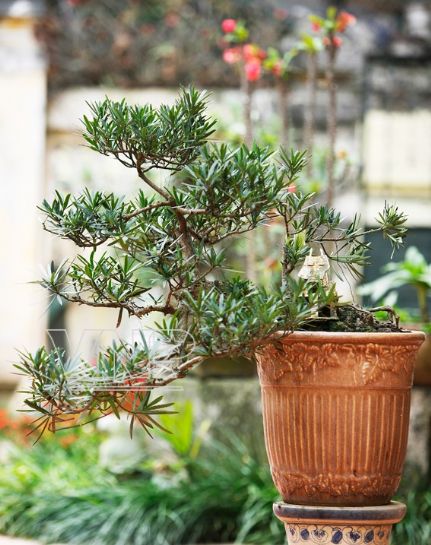
Horizontally
positioned Arhat tree.
|
|
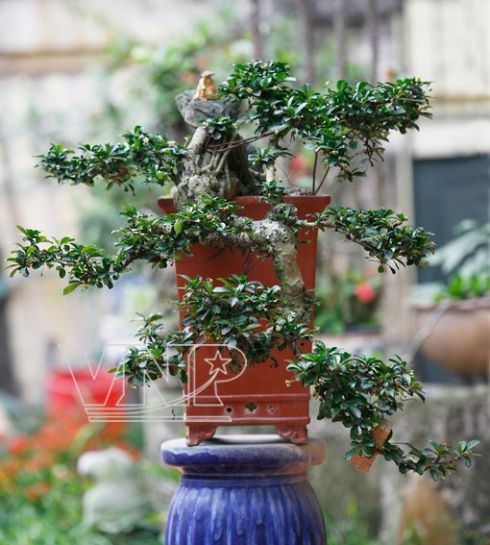
Fujian camellia tree.
|
|
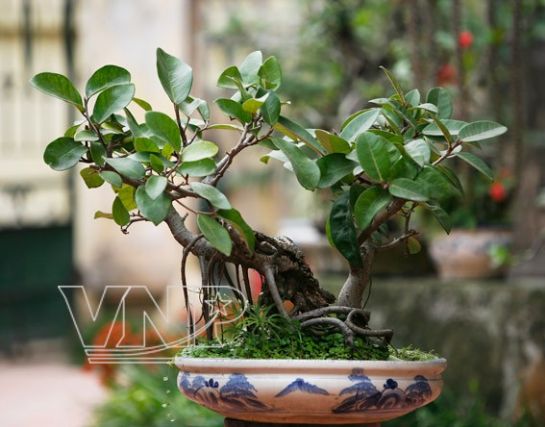
Vertically positioned banyan tree.
|
|
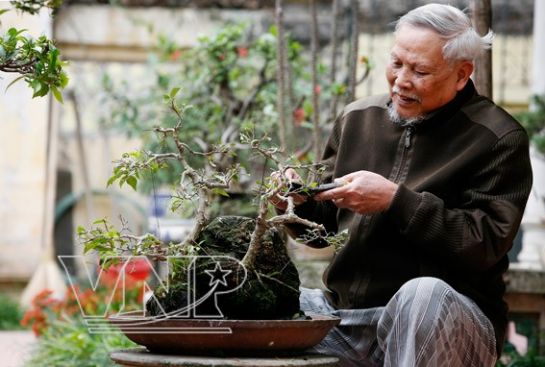
Artisan Le Huu Quyet prunes a double-trunked
plant.nbsp;
|
|
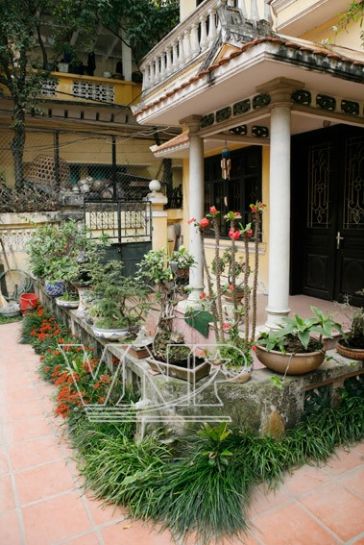
Ornamental trees help embellish
the outlook of the house.
| nbsp;
Residents in the capital in the old days and at
present have been interested in raising and enjoying ornamental plants,
called bonsai. The beauty of bonsai is different from the beauty of
flowers. Some may think that to raise a bonsai is simply to water and trim
the plants everyday to keep them green. In fact, it is an entirely hard
working process that requires creation and devotion of the grower. Bonsai
artisan Le Huu Quyen from
Hanoi
shares his experience,
saying: "The most difficult step is to shape the plant. A skilful artisan
will know how to tend the plant in such a way that it does not develop,
but gets stunted and small. The plant may be a dozen years old, but it is
only dozens of centimetres tall. With the artisan's trimming and shaping,
the plant develops beautiful and strange horizontal or vertical positions,
in the shape of a lying dragon, a pair of dancing dragons, dancing
phoenixes, etc.
Besides
changing the plant into a desired shape, the artisan can build up a new
one from those having original beautiful shapes. He grafts two plants
together sharing one root, or from one root he creates several plants,
which can be tall or short, but are attached to one another.
For
example, the banyan tree and fig tree have beautiful root, trunk and
branches, but their leaves are too big. To build up an ornamental mini fig
plant of less than 40-50cm tall with a small leaf canopy that can grow in
a small garden, the artisan has to cut off the original leaves, wait for
the new ones to grow and keep them not to develop by less watering the
tree. The young new leaves will live in a condition of shortage of water
and they can not develop normally, causing them to be stunted. At the
point of time when the tree has full leaves, the artisan will take care of
it with regular watering to keep them green.
To deal
with the roots, the artisan has to slightly raise the tree out of the
ground and place it into a new pot. After changing the pot several times,
the roots of the tree will be displayed on the surface. During this time,
if it rains, the artisan has to keep the pot inside the house or cover the
tree so that the water will not stay in the pot.
Nowadays,
bonsai growers like to "renovate" their plants by shaping them in such a
position that they will have highly aesthetic value, for example "a plant
holding a rock" (the roots go through the rocks, splitting-up and covering
the entire rock), or a plant having the fascicled root which grows off the
surface and is connected to one another.
Unlike
other forms of arts, bonsai is a lively multi-direction art which reflects
the passion of the grower. Each artisan has his/her own idea while
creating a work which he/she tries to blow a soul into.
Story by Tran Tri
Cong
Photos by Tat
Son |